
7 Best Oncologists in Faridabad for Tongue Cancer That Has Spread to Lymph Nodes in 2026

Introduction
You have just been told the tongue cancer has moved into the lymph nodes in your neck. The diagnosis lands like a physical blow. Your mind races past the biopsy report to a single, terrifying question: who in Faridabad can actually handle this?
You are no longer dealing with a localized tumor. Tongue cancer accounts for about 47% of all oral cancer cases in young people, and once it breaches the lymphatic highway, the stakes change irrevocably.
A single metastatic node at referral creates a 50% drop in 5-year survival for oral SCC patients. That statistic is the reason you need a specialist whose entire career has been built inside this specific fight.
The problem is that standard diagnostic scans are not nearly as reliable as you need them to be. About 30 per cent of tongue cancer patients develop occult metastases, hidden deposits of disease that physical exams, CT scans, and MRIs routinely miss. You need an oncologist who understands that the true extent of nodal spread is often invisible on imaging and who plans surgery accordingly. Aggressive, invisible spread demands an equally aggressive, expert-driven response the first time, because a failed initial surgery rarely gets a clean second chance.
This article profiles seven oncologists and cancer programs in Faridabad equipped to manage node-positive tongue cancer. It draws on institutional data, verified surgical expertise, and emerging biomarker research, including a protein called MMP10, which researchers at Tata Memorial Centre found can predict lymph node metastases with 86% accuracy. This development alone could spare many patients from unnecessary neck dissection. Your task is to find the surgeon who already integrates this level of precision into their decision-making.
Key Takeaways
Selecting the right oncologist for metastatic tongue cancer demands that you filter for very specific credentials, not general oncology experience. The following points summarize the non-negotiable selection criteria distilled from current research and treatment guidelines.
Surgical oncology specialization is mandatory: You need a dedicated head and neck surgical oncologist, not a general surgeon. Experience with complex metastatic cases and familiarity with sentinel lymph node biopsy techniques are baseline requirements for this disease stage.
Modified radical neck dissection is a core competency: Your surgeon must demonstrate a high-volume track record with lateral neck dissections that account for in-transit lingual lymph nodes, which are not currently included in standard diagnostic and treatment protocols despite impacting prognosis.
Multimodal treatment integration is the standard: Surgery alone is insufficient for node-positive disease. Your oncologist must lead or coordinate seamlessly with radiation and medical oncology teams to plan adjuvant therapy concurrent with surgical recovery.
Biomarker testing refines the surgical plan: MMP10 testing, capable of predicting nodal metastasis with 86% accuracy, can spare you a morbid neck dissection if truly negative. Insist on a surgeon who incorporates this or equivalent lymphographic tracing into the workup.
Reconstructive capability signals program depth: The ability to perform free-flap or pedicled flap reconstruction after a hemiglossectomy and radical neck dissection indicates a thorough surgical program, not a limited practice. This directly affects your speech, swallowing, and quality of life after the cancer is gone.
1. Dr. Bharat Patodiya’s Integrated Head & Neck Oncology Program, Faridabad
Dr. Bharat Patodiya’s practice runs on an integrated care model built exclusively around medical and head and neck oncology. He completed his core medical oncology training at Hinduja Hospital, Mumbai, followed by a 1-year Diploma in Lung Cancer and GI cancers from the University of Zurich, Switzerland, and a Certificate of Competence in Breast Cancer from Ulm, Germany. The program anchors itself in evidence-based, multidisciplinary coordination.
The care model extends beyond the operating room. Dr. Patodiya’s program, Pi Cancer Care, operates a fully equipped cancer treatment hospital in Hyderabad and now serves Faridabad patients through a coordinated care pathway. Each treatment cycle pairs with 24/7 nursing support.
The model coordinates second-opinion access with multidisciplinary tumor boards for protocol review. For node-positive disease, the sequence of surgery, radiation, and systemic therapy must be choreographed precisely to avoid treatment gaps that allow microscopic nodal deposits to flourish. The program also coordinates screening referrals and connects patients with diagnostic facilities offering transparent pricing, including PET-CT support programs.
For a patient with tongue cancer that has spread to lymph nodes, the program systematically removes coordination friction. Dr. Patodiya personally coordinates trial enrollment alongside insurance claims, and the tumor board reviews are weekly rather than ad hoc. This means your case transitions from surgical assessment to radiation planning without the weeks of delay that can occur when you, the patient, are forced to be the messenger between disconnected specialists. The program acknowledges the financial reality of cancer care with transparent pricing structures, listing a consultation at a sale price of ₹1,050. His biography states his areas of interest include lung, breast, and gastrointestinal cancers, and he integrates palliative acupuncture techniques as a component of supportive oncology for advanced disease patients.
2. Surgical Oncology Experts at Sarvodaya Hospital, Faridabad
Dr. Naveen Sanchety has directed surgical oncology at Sarvodaya Hospital for over 19 years. His practice concentrates on the head and neck procedures that oral cancer demands: tongue resections requiring cervical lymph node clearance, and recurrent ameloblastoma management. Patient testimonials on his profile reference both, which signals a caseload that regularly confronts aggressive oral cavity pathology.
His published work reveals the same methodical approach. Peer-reviewed studies on axillary lymph node ratio as a prognostic factor, malignant granular cell tumor of the breast, and PET-CT as a prognostic tool in primary breast cancer all share a common thread, staging accuracy before the first incision. That orientation carries into the head and neck room, where knowing the nodal map changes the surgical plan.
The institutional layer matters as much as the surgeon. Sarvodaya runs a dedicated hospital-based pathology lab that delivers frozen sections during surgery. The surgeon knows whether the margins are clear while you are still on the table.
For a hemiglossectomy with modified radical neck dissection, this feedback eliminates the possibility of a positive margin surfacing days later on permanent section and forcing a second operation. The hospital's critical care coverage addresses what happens after.
A post-operative airway complication following neck dissection is managed by an in-house intensivist team. No transfer, no delay.
3. Head & Neck Surgical Team at Asian Institute of Medical Sciences, Faridabad
The Asian Institute of Medical Sciences fields a dedicated head and neck surgical team within its accredited tertiary care framework. For node-positive tongue cancer, the institute's process centers on multidisciplinary staging accuracy followed by integrated treatment sequencing. The table below compares the decision dimensions that separate a hospital-based tumor board from fragmented referrals, a structure that directly affects your outcome when lymph nodes are involved.
Decision Dimension | Asian Institute of Medical Sciences Model | Fragmented Referral Model |
Treatment Planning | Single-session tumor board with surgical, radiation, and medical oncology present simultaneously | Sequential, patient-directed referrals with weeks between specialist opinions |
Adjuvant Therapy Timing | Radiation start date coordinated during surgical planning to minimize post-op gap | Gaps of 6 to 10 weeks common while patient secures radiation oncology appointment independently |
Pathology Integration | Institutional pathologist present at tumor board to clarify histopathological risk factors | Outside pathology slides must be physically transferred and re-read, introducing delay |
Clinical Trial Access | Centralized institutional review board streamlines enrollment eligibility screening | Patient must independently identify and pursue trial options at external centers |
Reconstructive Coordination | Plastic surgeon included in initial tumor board for immediate free-flap planning | Reconstructive consult often arranged only after ablative surgery is complete |
The critical path for node-positive disease is the interval from surgery to the initiation of adjuvant radiation. Every week of delay beyond six weeks allows microscopic residual disease in the cervical nodes to repopulate. At Asian Institute, radiation oncology sits in the initial staging conference. The team reviews your pre-operative PET-CT together and agrees on the radiation fields before your neck dissection even occurs. When the final pathology returns showing three positive nodes with extracapsular extension, the radiation plan is already templated, ready to start immediately.
4. Radiation Oncologists at Fortis Escorts Hospital, Faridabad
Adjuvant radiation changes the odds when tongue cancer reaches the cervical lymph nodes. Without it, a neck recurrence is exponentially harder to salvage. Fortis Escorts Hospital delivers this capability with advanced linear accelerator technology, including intensity-modulated radiation therapy (IMRT) and image-guided radiation therapy (IGRT). These modalities spare your spinal cord, remaining salivary glands, and mandible while delivering tumoricidal doses to the post-operative neck and primary tongue bed.
The radiation oncologist you select must understand the lymphatic geography of the tongue at a granular level. The in-transit lingual lymph nodes, those unpredictable deposits along the drainage route to neck levels I and II, often sit outside standard radiation target volumes. If your surgeon did not specifically address them during neck dissection, the radiation oncologist must recognize this gap and contour those at-risk regions into the clinical target volume. Fortis Escorts' radiation team routinely manages post-operative head and neck cases, so the physicists and dosimetrists are calibrated to the tight margins and steep dose gradients these plans demand.
5. Multidisciplinary Panel at Metro Hospital, Faridabad
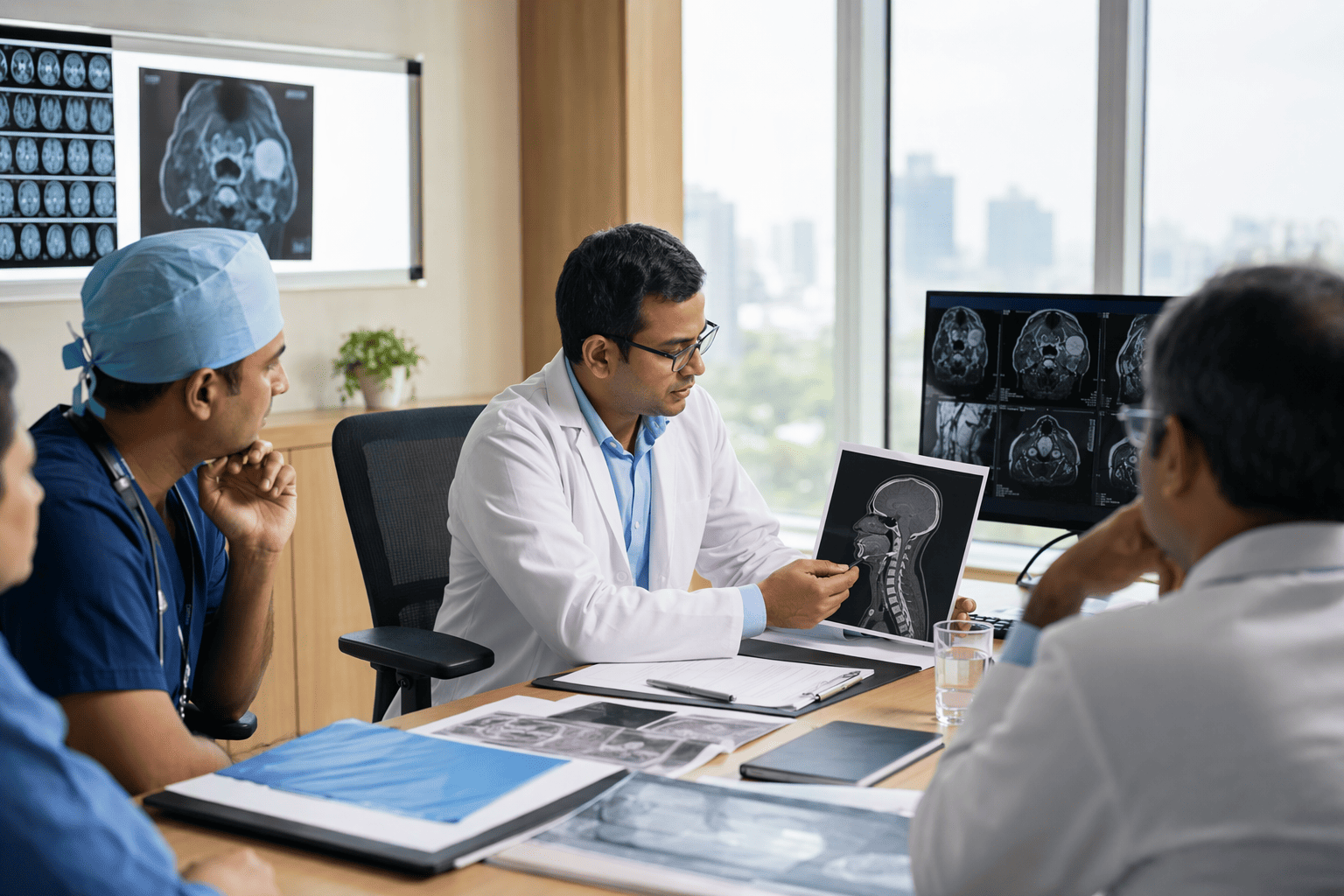
A functioning tumor board forces treatment decisions before gaps can open, which matters in node-positive disease where delays carry real risk. Metro Hospital's multidisciplinary panel convenes the surgeon, radiation oncologist, and medical oncologist for every stage IV tongue cancer case and generates a single coordinated treatment sequence through joint deliberation. Here is how that process should unfold for your case.
Pre-treatment staging conference: The surgeon, radiation oncologist, and medical oncologist review your PET-CT, biopsy histopathology, and clinical exam findings together. They stage the nodal disease precisely and agree on the primary treatment modality, typically surgical resection with neck dissection.
Surgical planning with reconstructive input: The ablative surgeon and reconstructive surgeon mark the planned resection margins, the extent of neck dissection (levels I through V if indicated), and the free-flap donor site. They agree on a backup plan if frozen sections return positive.
Immediate post-operative pathology review: Within 48 hours of surgery, the full panel reconvenes with the final pathology in hand. They tally the total positive nodes, check for extracapsular extension, and measure the closest margin. If the tumor was poorly differentiated or showed ≥3 tumor buds, a known histopathological predictor of late metastasis, the medical oncologist escalates systemic therapy urgency.
Concurrent treatment coordination: Radiation planning begins during wound healing, with the medical oncologist concurrently prescribing cisplatin or cetuximab. The panel sets a hard deadline for radiation start, typically no later than six weeks post-operatively, and the nurse navigator books the simulation and first fraction to enforce it.
6. Skull-Base & Reconstructive Surgeon at Accord Superspeciality Hospital, Faridabad
You will not fully appreciate the reconstructive surgeon's role until you wake up from a hemiglossectomy with a neck dissection and try to swallow your own saliva. Accord Superspeciality Hospital has a skull-base and reconstructive surgery capability inside its oncology program, a specific skill set that transforms the functional outcome of aggressive tongue cancer surgery. When the primary tumor requires a near-total or hemiglossectomy to achieve clear margins, the resulting defect cannot simply be closed primarily without turning the remaining tongue into a scarred, immobile stump. You would lose both speech intelligibility and the ability to propel a food bolus posteriorly.
Free-flap or pedicled flap reconstruction marks a thorough program. A radial forearm free flap harvests skin and fascia from the wrist along with its arterial supply, and microvascular surgeons at Accord re-establish blood flow by anastomosing it to vessels in the neck. The flap restores tissue bulk to the oral cavity, giving the remaining native tongue a mobile surface to contact during articulation.
Accord Superspeciality Hospital's inclusion of skull-base surgery signals a department that handles disease extending posteriorly toward the oropharynx and base of skull, a frequent finding in neglected or rapidly progressing tongue primaries. If your staging scans show involvement of the pterygoid muscles or the floor of the mouth extending deep toward the mandible, you need a team with this anatomical reach. The capability to perform a segmental mandibulectomy and immediately reconstruct the jaw with a fibula free flap, coordinated by the same team at the same surgical session, avoids the disfiguring, functionally crippling outcome of an unreconstructed composite resection.
7. Thorough Cancer Care Unit at QRG Health City, Faridabad
QRG Health City packages its oncology services as a thorough cancer care unit. The structure collapses the usual diagnostic-to-treatment timeline. For node-positive tongue cancer, the handoff delays between PET-CT scheduling, surgical consultation, and radiation oncology mapping eat weeks that microscopic cervical disease uses to consolidate. A thorough unit co-locates these services, meaning your staging scan, the surgeon's review, and the tumor board discussion happen inside the same physical infrastructure, often within the same working week.
This model addresses a specific access bottleneck. In fragmented care, a patient diagnosed on biopsy waits ten days for a surgical consult, then two weeks for a PET-CT slot, then another ten days for the medical oncologist to review the scan, and suddenly a month has vanished before the neck dissection is even scheduled. QRG Health City's integrated workflow targets a compressed diagnostic phase where a PET-CT scan is obtained and read within days of the initial surgical evaluation. The medical oncologist sees the same images on the same institutional PACS system, eliminating the need to courier discs or re-upload outside studies.
The thorough unit also centralizes the therapy sequencing that follows surgery. When your final pathology returns showing ≥4 positive nodes, a known prognostic indicator for distant metastasis risk, the medical oncologist embedded in the unit accelerates the discussion about concurrent versus sequential chemoradiation. The radiation oncology team, using the same electronic medical record, already has your pre-operative PET-CT registered for fusion with the planning CT. Your simulation appointment is booked before your surgical drain comes out, and the entire pathway is tracked by a single institutional dashboard rather than a collection of independent clinics keeping separate charts. This systemic coordination keeps your cancer care a single clinical episode, with every step visible to every specialist on your team.
Conclusion
Tongue cancer with lymph node spread demands a head and neck surgical oncologist who works inside a defined, multimodal team. Your survival turns on how tightly that team coordinates radiation, chemotherapy, and reconstruction from day one.
Assess each surgeon against specific yardsticks: neck dissection volume, how their tumor board reviews cases before a knife touches your neck, and their fluency with the biomarkers that now predict nodal spread. These markers can spare selected patients a neck dissection when the risk scores low. Use the profiles above. Ask the questions your pathology report demands answered.
Book the first consult with the surgeon who answers them without hesitation.
Frequently Asked Questions
Who are the most experienced oncologists in Faridabad for treating metastatic tongue cancer?
The most relevant specialists are head and neck surgical oncologists practicing within integrated institutional programs.
Dr. Naveen Sanchety at Sarvodaya Hospital holds 19-plus years of experience with robotic surgery credentials and published head and neck cancer outcomes.
Dr. Sugandha Arya at Accord Superspeciality Hospital represents surgical oncology with skull-base and reconstructive depth.
Hospital-based tumor board panels at Asian Institute, Metro, and QRG Health City coordinate multi-specialist input key for node-positive disease.
What credentials and specializations should I look for in an oncologist for tongue cancer that has spread to lymph nodes?
Insist on a head and neck surgical oncologist with specific qualifications and institutional support.
They must hold an M.Ch in the subspecialty or equivalent fellowship training.
Verify documented experience with modified radical neck dissection and sentinel lymph node biopsy.
The surgeon should operate within a system that offers integrated radiation oncology with IMRT/IGRT and accredited pathology for intraoperative frozen sections.
FACS or equivalent international fellowship signals peer-verified surgical standards.
What treatment options are available for advanced tongue cancer with lymph node involvement in India?
Standard treatment is multimodal, combining surgery with adjuvant therapies and advanced techniques.
Surgical resection of the primary tumor with ipsilateral or bilateral neck dissection is the first step.
Adjuvant radiation, often concurrent with chemotherapy like cisplatin, follows surgery.
Advanced centers offer IMRT for precision targeting and free-flap reconstruction for functional restoration.
Systemic options include cetuximab-based targeted therapy for cisplatin-ineligible patients, and immunotherapy for refractory disease, coordinated through institutional tumor boards.
How do I verify an oncologist's expertise in head and neck cancers and their track record with complex cases?
Evaluate a surgeon's expertise using targeted questions and verifiable evidence.
Request their specific neck dissection volume for the past year, not overall oncology numbers.
Ask for outcomes data on positive margin rates and nodal yield in their tongue cancer resections.
Review their published research on platforms like PubMed for head and neck-specific papers.
Seek patient testimonials that reference tongue cancer or neck dissection specifically, not general cancer survivor stories.
What questions should I ask an oncologist during the first consultation for metastatic tongue cancer?
Ask these specific questions during your consultation to gauge the surgeon's precision and team integration.
How many modified radical neck dissections do you perform annually?
Do you include lingual lymph nodes in your surgical and radiation target volumes?
What is your personal positive margin rate on T2-T4 tongue primaries?
Does your tumor board meet weekly with radiation and medical oncology present?
How do you incorporate MMP10 or sentinel node biopsy into the decision for neck dissection extent?
What is the typical prognosis and treatment journey for tongue cancer that has metastasized to lymph nodes?
The presence of a single metastatic lymph node reduces 5-year survival by approximately 50% compared to node-negative disease. The journey spans surgical resection with neck dissection, a 4 to 6-week healing window, then 6 to 7 weeks of adjuvant radiation, often with concurrent chemotherapy. Long-term surveillance with PET-CT at 3 to 6-month intervals follows for at least two years, as the risk of second primary aerodigestive tract tumors is 3 to 7% per year.
Sources
Lingual lymph nodes: Anatomy, clinical considerations, and oncological significance - PMC - pmc.ncbi.nlm.nih.gov
A Study of the Prognostic Factors for Late Cervical Lymph Node Metastasis and Distant Metastasis in Patients with cT1-2N0 Tongue Cancer. - pubmed.ncbi.nlm.nih.gov
Best Surgical Oncologist in Faridabad, Delhi NCR India - www.sarvodayahospital.com
Tongue Cancer Treatment in Delhi | Advanced Tongue Cancer Care at RGCIRC - www.rgcirc.org

Comments