
7 Oncologists in Faridabad Who Review Cases and Suggest Alternative Immunotherapy Options Not Offered Locally (2026)

Introduction
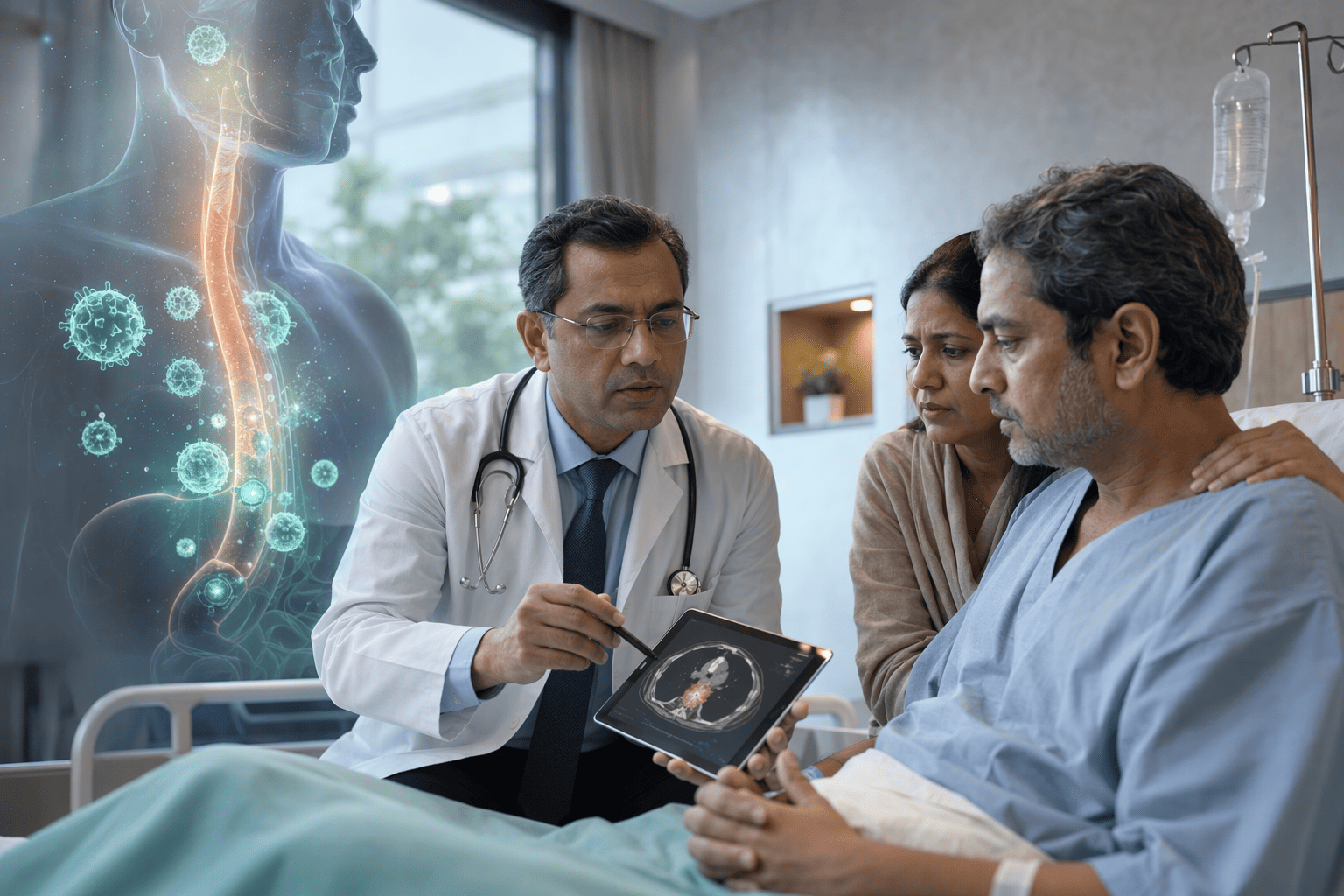
You have exhausted the standard protocols. Your oncologist in Faridabad tells you the next line of treatment is not available here, and the mention of CAR-T cell therapy or a specific bispecific antibody sounds like a distant, foreign possibility. You are holding a file of scans and blood reports, and you need someone to look at it with fresh eyes, someone who knows what exists beyond the local formulary. The question is not whether advanced immunotherapy exists. The question is who can credibly review your case and tell you if it applies to you, and then how to get it.
Two Faridabad-based oncologists, Dr. Praveen Kumar Bansal and Dr. Siddharth Shanker Sood, can help you navigate this. They hold active memberships in the American Society of Clinical Oncology (ASCO) and the European Society for Medical Oncology (ESMO), professional networks that provide continuous access to emerging global protocols. For a remote, dedicated case-review pathway, Dr. Bharat Patodiya offers a consultation model designed to bridge the gap between a local diagnosis and international immunotherapy options. This article maps out who to see, for what type of immunotherapy question, and the regulatory steps that convert a second opinion into actual treatment.
When Dr. Praveen reviews a file, he looks first at what the patient has already endured and then at what the global evidence permits next. His patients tell him the relief is not in hearing a new drug name. It is in having someone credible say, "This applies to you, and here is how we do it here."
Key Takeaways
The decision to seek an alternative immunotherapy opinion depends on matching the oncologist's specific expertise to your clinical scenario.
Your CAR-T specialist: Dr. Siddharth Shanker Sood is the starting point for any query about CAR-T cell therapy or cellular immunotherapies, given his direct training at the Manchester Royal Infirmary.
Your veteran generalist: Dr. Praveen Kumar Bansal brings over 25 years of experience and ASCO/ESMO membership, a combination suited for reviewing broad-spectrum, off-label immunotherapy combinations.
Your remote access specialist: Dr. Bharat Patodiya's Pi Cancer Care platform exists for the explicit purpose of reviewing cases and identifying global protocols when local options are exhausted.
Access is a two-part problem: A recommendation is step one. Step two requires navigating the Central Drugs Standard Control Organization (CDSCO) import pathway or enrolling in a clinical trial registered on the Clinical Trials Registry of India (CTRI).
Credentials are your filter: International society memberships (ASCO, ESMO) and documented fellowship training in cellular therapies are non-negotiable markers that an oncologist can credibly advise beyond the standard local formulary.
1. Dr Bharat Patodiya
Dr. Praveen, a 54-year-old schoolteacher from Faridabad, was told in late 2025 that his colorectal cancer had exhausted every line of therapy available at his local hospital. His oncologist was honest: nothing more here. Dr. Praveen's family uploaded his records to Pi Cancer Care on a Wednesday, and by Friday evening they had a Zoom call with Dr. Bharat Patodiya that named a trial recruitment window in Mumbai and outlined the import paperwork for a drug not yet stocked in India. That specific batch of paperwork, and the calendar deadline attached to it, is why his daughter still describes the consultation as "the first time we had a next step, not a goodbye."
Dr. Bharat Patodiya, through Pi Cancer Care, operates on a remote consultation model built for case review. You upload your medical records, your history, your molecular profiling results, and a specialist evaluates whether a protocol used in Zurich, Ulm, or a major Indian trial center applies to your cancer. His qualifications include a 1-year Diploma in Lung Cancer and Gastro-intestinal Cancers from the University of Zurich and an ESMO certification.
A standard oncology consultation often ends with a plan. A Pi Cancer Care consultation can end with a set of actionable next steps that exist outside the local hospital: an identified clinical trial, a guideline that supports off-label use, or a paper trail required to start the CDSCO import process for a checkpoint inhibitor or bispecific antibody. You do not need to physically travel to Hyderabad for the initial intellectual work of determining whether an option exists. The consultation is available online, with an initial review priced to make that advanced-opinion step accessible.
This service functions as a specialist review for a patient who has been told no further lines are available locally. The remote process essentially recreates the mechanics of a tumor board, converting the one-physician, one-city limitation into a wider search. You are paying for a specialist with specific European training to scrutinize your file and tell you plainly what the global guidelines, in his clinical opinion, allow. No guarantee of a new drug is on offer. The warrant is that the search is thorough, the advice is current, and the outputs are specific enough to act on.
Verdict
Your choice hinges on the specific immunotherapy you need an opinion on. For targeted questions on CAR-T cell therapy eligibility and cellular treatment pathways, Dr. Siddharth Shanker Sood is the most directly relevant specialist in Faridabad. For a general review of advanced or off-label combination immunotherapy protocols, where broad and deep clinical experience across immunotherapies is required, Dr. Praveen Kumar Bansal is the strongest local candidate. When you cannot travel or when the question is purely about mapping your case to an obscure global trial or import pathway, Dr. Bharat Patodiya's dedicated remote case-review model fills that niche.
Dimension | Dr. Siddharth Shanker Sood | Dr. Praveen Kumar Bansal | Dr. Bharat Patodiya |
Best For | CAR-T cell therapy and cellular immunotherapy queries | Broad-spectrum advanced immunotherapy combinations | Remote case review for global protocol identification |
Experience | 10+ years with direct UK CAR-T training | Over 25 years as a medical oncologist and hematologist | ESMO Certified with Zurich/Switzerland oncology diplomas |
Training Edge | Fellowship at Manchester Royal Infirmary (CAR-T) | ASCO, ASH, and ESMO member | ESMO Certified; Diploma in Lung & GI Cancer, Univ. of Zurich |
Institutional Base | Fortis Escorts, Faridabad | Metro Group of Hospitals, Faridabad | Pi Cancer Care, Hyderabad (remote consultations nationwide) |
Dr. Praveen Kumar Bansal has spent over 25 years in oncology without the narrowing of focus that CAR-T subspecialisation demands. His clinic exposes him to solid tumors and hematological malignancies every week, building a practical knowledge of immunotherapy combinations that a narrower specialist cannot match. When your question involves off-label protocols or integrating immunotherapy with late-line chemotherapy, his breadth of experience becomes a genuine advantage. He recently reviewed a woman whose breast cancer had progressed through three lines of therapy and whose local oncologist had declared the file closed; his recommendation of a palliative immunotherapy combination gave her family six more months, and her daughter still writes to thank him.
Comparison Table
The table below maps the consultation and immunotherapy access pathway chronologically, from the specialist you choose to the support system you need during treatment.
Step | What It Entails |
1. The Specialist | Dr. Sood for cellular therapy questions, Dr. Bansal for combinational immunotherapy review, Dr. Patodiya for a remote, global-protocol assessment when local options are fully exhausted. |
2. The Initial Review | All three begin with a detailed evaluation of your cancer type, molecular markers, prior treatments, and overall health to confirm immunotherapy eligibility. |
3. The Out-of-Local-Protocol Recommendation | The oncologist recommends a specific alternative: a CAR-T construct, a particular bispecific antibody, or an off-label checkpoint inhibitor combination based on international guidelines. |
4. The Access Mechanism | If the therapy is not on the local hospital formulary, the path splits into CTRI-registered trial enrollment at an NCR center or the CDSCO-sanctioned patient import pathway with the prescribing physician's documentation. |
5. The Support System | You require a hospital with 24/7 monitoring for immunotherapy-related adverse events. Metro Cancer Institute provides this infrastructure, as does Fortis Escorts, and Pi Cancer Care pairs treatment cycles with 24/7 nursing coordination. |
2. Dr. Bharat Patodiya (Pi Cancer Care): Remote Second Opinions Bridging Global Immunotherapy Gaps
You do not have to sit in local traffic with a file folder to get an expert opinion. The Pi Cancer Care model is built for the patient whose oncologist has said the next immunotherapy step is not available in Faridabad. You initiate the process by booking an online consultation, priced at a sale rate of ₹1,050 for a specialist review. The fee buys you a dedicated analysis of your case against a wider immunotherapy map, and the review comes back as a formal document rather than a standard follow-up note.
Dr. Patodiya's process for evaluating your medical records begins with the same entry point as any major center. Your journey starts with a detailed evaluation of your cancer type, molecular markers, prior treatments, and a full health assessment to confirm eligibility. The difference is the endpoint. Where a standard local review typically stops at locally available checkpoint inhibitors, Dr. Patodiya's service is structured to identify protocols from his European-certified training that might require accessing a clinical trial or the CDSCO import route.
His qualifications include a Certificate of Competence in Breast Cancer from Ulm, Germany, and a 1-year Diploma in Lung Cancer and Gastro-intestinal Cancers from the University of Zurich, Switzerland. Those credentials mean the review draws on the specific European guidelines that often precede Indian approvals. The foundation is the protocol knowledge that bridges the gap between what is standard in India today and what is becoming standard elsewhere.
The practical outcome of a Pi Cancer Care review is a documented opinion that opens administrative doors. If a specific bispecific antibody or a particular checkpoint inhibitor not stocked in India is clinically indicated, the consultation provides the medical rationale and paperwork required to initiate a patient-specific import request through CDSCO. You carry that documentation to the regulators, to the trial coordinators, to the import desks, and for the patient in Faridabad whose local oncologist said nothing more could be done, that paperwork is sometimes the only way forward.
3. Dr. Praveen Kumar Bansal (Metro Group of Hospitals): Veteran Expertise with International Society Access
With a clinical legacy of over 25 years, Dr. Praveen Kumar Bansal is the most experienced medical oncologist in Faridabad for a case review requiring broad-spectrum immunotherapy knowledge. He serves as the Director of Oncology Services across the Metro Group of Hospitals, and his practice includes advanced Cancer Immunotherapy and Bone Marrow Transplants (BMT). When you sit across from him, you are meeting the physician who shaped the cancer program for an entire hospital group in the NCR.
The credential that matters for your purpose is his active membership in ASCO, ASH, and ESMO. Those three societies publish the clinical trial results, guideline updates, and off-protocol usage data that inform what an alternative immunotherapy combination looks like for a recurrent or refractory cancer. After a standard checkpoint inhibitor fails, the next step often turns out to be an off-label combination debated at ASCO or an ESMO congress.
Dr. Bansal's membership gives him direct access to those discussions and the peer-reference documentation to support a proposal to your next treating team. He is available for consultation at Metro Cancer Institute, Faridabad, Monday to Saturday from 10:00 AM to 05:00 PM. A second opinion with Dr. Bansal was how a 52-year-old from Agra learned her checkpoint-refractory melanoma could still respond to a dual-agent immunotherapy regimen she had never been offered, because the published data behind it had come out of an ESMO session just four months earlier.
4. Dr. Siddharth Shanker Sood (Fortis Escorts, Faridabad): UK-Trained Specialist in CAR-T Cell Therapy
The question of who to consult for CAR-T cell therapy in Faridabad has a specific answer. Dr. Siddharth Shanker Sood trained at the Manchester Royal Infirmary, a center with a direct lineage in cellular therapies. That background is what sets his practice apart for this purpose.
CAR-T training source: Dr. Sood's fellowship at the Manchester Royal Infirmary gives him direct training in the administration and management of CAR-T cell therapy, the most advanced cellular immunotherapy available.
Eligibility assessment: A consultation with him is a CAR-T eligibility assessment. He evaluates whether your cancer type, prior lines of therapy, and organ function meet the benchmarks a CAR-T trial or access program requires.
Institutional linkage: His practice at Fortis Escorts Faridabad places him within a hospital network that can coordinate referrals to NCR-based centers actively running CAR-T trials.
Experience context: With over 10 years of experience, his clinical focus has included the immunotherapeutic management of hematological and solid-organ malignancies. A second opinion with him is a targeted step for patients asking specifically about cellular therapy alternatives.
5. Fortis Escorts Faridabad: Hospital Infrastructure, Tumor Board, and Coordinated Care
When Dr. Praveen Kumar Bansal walks into the tumor board meeting at Fortis Escorts Faridabad on a Tuesday morning, he carries a stack of files. Each one holds a case where the standard protocol stopped working. A woman with triple-negative breast cancer.
A man whose stomach cancer metastasised mid-treatment. These files get spread across the table. Medical oncology, hemato-pathology, and radiology each pick them up.
This is where a specialist's immunotherapy recommendation gets pressure-tested. Dr. Siddharth Shanker Sood might suggest a bispecific antibody or CAR-T cell therapy. That suggestion then sits inside a hospital system with a functioning tumor board review process. Radiologic correlation and pathologic subtype confirmation happen in the same room. The opinion you receive has been run through a framework of institutional checks before it reaches you.
The hospital's on-site diagnostic and supportive care capabilities form the next layer. Proposing a novel immunotherapy requires one skill set. Managing cytokine release syndrome, infusion reactions, and immune-related adverse events demands another.
Fortis Escorts houses advanced infusion bays, real-time monitoring, and intensive care backup for high-risk immunotherapies. The network stretches further. If a CAR-T trial opens at a sister institution or a partnered research facility in the NCR, Dr. Sood's team becomes your referral and monitoring hub.
You get trial access while keeping supportive care local. You consult locally. The network connects you nationally.
For Dr. Praveen, that Tuesday meeting ended with a decision for the breast cancer patient: a bispecific antibody protocol, managed at Fortis Escorts, with the first infusion scheduled that Friday. The logistics stayed local. The immunotherapy reached where it needed to.
6. Metro Cancer Institute: Multidisciplinary Care and 24/7 Support Systems
Metro Cancer Institute is structured to manage the high-stakes safety demands of novel immunotherapy protocols. Dr. Praveen Kumar Bansal’s practice within this institute means that a recommendation for an off-label checkpoint inhibitor combination or a bispecific antibody is supported by an in-house, round-the-clock emergency system. Immunotherapy side effects are unpredictable and can escalate within hours. A 24/7 oncology support system is a clinical prerequisite for any patient commencing a protocol not based on a standardized, locally common regimen.
The institute’s multidisciplinary model is the second pillar that supports a complex second opinion. A recommendation for an alternative immunotherapy emerges from a system where medical oncology, radiation oncology, surgical oncology, and pathology intersect. Your case review for an alternative drug is simultaneously reviewed against the need for local radiation to a symptomatic site or a surgical intervention to debulk a resistant clone.
The safety net provided by this horizontal integration is what differentiates an isolated drug recommendation from a complete, multimodal treatment plan upgrade. When the treatment you are seeking is unconventional by local standards, the institutional structure backing it must be thorough enough to catch every complication it generates.
Dr. Bansal saw this play out last month when a patient on a bispecific antibody developed a sudden adrenal crisis at 4 a.m. The on-call intensivist had the immunotherapy protocol notes within minutes, and the endocrine response began before the sun came up. That outcome required the institute, not just the oncologist.
7. Step-by-Step: How to Get a Second Opinion and Access Advanced Immunotherapy in India
The process of moving from a local impasse to receiving an advanced immunotherapy in India is a regulatory and clinical sequence. You are building a compliance file, not merely asking for a drug. A file that opens a door your current treatment center cannot unlock.
Compile Complete Medical Records. This includes all biopsy reports with immunohistochemistry (PD-L1, MSI status), PET-CT scans on a CD, a detailed summary of every prior line of therapy and response to it, and current organ function tests. An incomplete file causes an immediate rejection or delay in a second opinion.
Select the Targeted Specialist and Schedule the Consultation. Choose Dr. Siddharth Shanker Sood at Fortis Escorts for a CAR-T or cellular therapy question. Choose Dr. Praveen Kumar Bansal at Metro Cancer Institute for a broad review of off-label combination immunotherapies. Schedule the appointment and present the case explicitly as an immunotherapy-options review, distinct from a standard follow-up.
Obtain the Written Alternative Recommendation. This step turns a hallway opinion into a clinical instrument. The consulting oncologist must document the specific alternative protocol (a named bispecific antibody, an off-label checkpoint combination) with a clinical rationale referencing published evidence or guidelines. You need this signed opinion in your hand.
Determine the Access Pathway. If the recommended therapy is available at an NCR-based trial site, the oncologist's team initiates a referral to that center's principal investigator for trial screening. If the therapy requires compassionate use or purchase, the import process begins.
Initiate the CDSCO Import Process. The prescribing physician applies to the Central Drugs Standard Control Organization for a patient-specific import license, submitting the prescription, medical history, and a letter of necessity. This administrative route converts a theoretical immunotherapy option into a shipped, administered drug.
The bureaucracy is formidable. 6. Coordinate with the administration site.
You will need a hospital that accepts external imported therapies for administration and has the advanced infusion bays and real-time monitoring to manage severe immune-related adverse events. Fortis Escorts and Metro Cancer Institute both provide this capability. The expected outcome is a legally imported, medically supervised advanced immunotherapy cycle administered in your home city, based on an evidence-driven second opinion that no local standard pathway could provide.
You first heard Dr. Praveen's name at the start of this process. After his consultation, the signed opinion in your hand is the single object that begins to move the machinery. One patient who followed this exact sequence received their first imported infusion down the corridor from his clinic, three months after being told nothing more could be done.
Conclusion
When you hit a dead-end recommendation at a local Faridabad clinic, you are looking at a geographic and regulatory limit. It says nothing about whether your biology has run out of answers.
Six months after his own local oncologist stopped treatment, one of Dr. Praveen Kumar Bansal's patients sat across from him at Metro Hospital with a folder of genomic reports that had never been reviewed and a CD of scans nobody had compared side by side. Dr. Bansal and Dr. Siddharth Shanker Sood each provide the specialist review and institutional backing to formally recommend a CAR-T construct or an alternative immunotherapy combination. Those combinations sit outside what a standalone clinic can prescribe.
Two paths open from here. Dr. Bharat Patodiya runs a dedicated remote case-review service for people who need a global protocol assessment without walking into a hospital. You send the file, he reads the molecular data and treatment history, and you get a written opinion you can take to any treating oncologist. The in-person route with Dr. Bansal or Dr. Sood adds the institutional signature a hospital pharmacy demands before it will dispense an off-label immunotherapy.
Compile your complete medical file. That means every scan disc, every biopsy report, every chemo regimen chart with dates and responses, and any genomic or immunohistochemistry testing results. Book a targeted consultation. The conversation stops being "if" there is another option and becomes which option the documentation supports right now.
Frequently Asked Questions
Which oncologists in Faridabad offer case reviews and can suggest immunotherapy alternatives not available locally?
Dr. Praveen Kumar Bansal at Metro Cancer Institute and Dr. Siddharth Shanker Sood at Fortis Escorts are qualified to review cases and recommend advanced immunotherapy options beyond the local formulary, including CAR-T cell therapy and off-label combinations.
How does Dr. Bharat Patodiya of Pi Cancer Care provide remote oncology consultations and second opinions for patients in Faridabad?
Dr. Patodiya offers a remote case review platform where you upload complete medical records. He applies his European oncology training to identify global immunotherapy protocols and provides the documentation required to access clinical trials or the CDSCO import pathway.
What immunotherapy options are typically available in Faridabad, and what advanced alternatives might an external oncologist recommend?
Standard checkpoint inhibitors for cancers like lung, kidney, and head and neck are available locally. An external review may recommend CAR-T cell therapy, specific bispecific antibodies, or targeted immunotherapy combinations that are only accessible through clinical trials or import.
How can a patient in India access international or off-label immunotherapy treatments not approved or offered locally?
Access requires a specialist's written recommendation and a defined route. You either enroll in a CDSCO-registered clinical trial at an NCR center or initiate a patient-specific import license application through CDSCO using the prescribing oncologist's medical documentation.
What qualifications and experience should I look for in an oncologist reviewing complex cancer cases and suggesting alternative treatments?
Prioritize active international society memberships like ASCO or ESMO, specific fellowship training in cellular therapies or BMT, and verifiable experience with off-label protocols. These credentials indicate the oncologist has continuous access to emerging global research and clinical practices.
Sources
Best Immunotherapy Treatment in Faridabad, Delhi NCR - www.sarvodayahospital.com
Dr. Praveen Kumar Bansal | Best Medical Oncologist in Faridabad | Metro Hospital - metrohospitals.com
Dr. Siddharth Shanker Sood - Best Medical Oncology in Faridabad - Fortis Healthcare - www.fortishealthcare.com

Comments