
Is There Treatment When Leukemia Returns After Chemotherapy? 2026 Guide

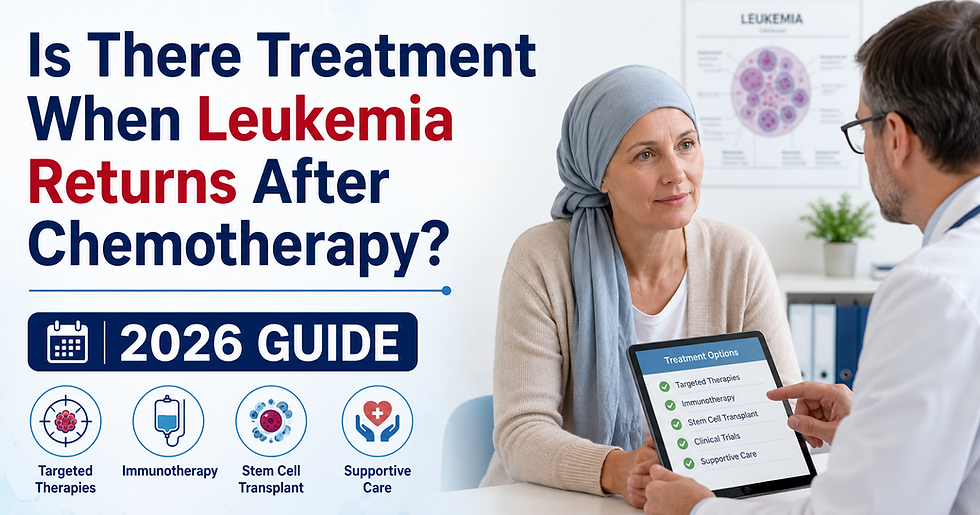
When leukemia returns after chemotherapy, multiple evidence-based treatments remain available, including CAR-T cell therapy, stem cell transplant, targeted immunotherapy, and clinical trials. Treatment selection depends on relapse timing, patient fitness, leukemia subtype, and whether the disease returned within or after 12 months of achieving remission.
Key Takeaways
Multiple treatment options exist for relapsed leukemia, with cure still possible depending on timing and patient fitness
Early relapse (within 12 months) requires aggressive approaches like CAR-T therapy or stem cell transplant, while late relapse may respond to salvage chemotherapy
CAR-T cell therapy costs ₹30-50 lakhs in India compared to ₹3-4 crores internationally, with 83-98% complete remission rates for B-cell leukemia [6]
Stem cell transplant remains the curative standard for early AML relapse in fit younger patients, requiring donor matching and rigorous eligibility screening [7]
Thorough evaluation protocols help determine eligibility for advanced therapies before committing to full treatment
Yes, multiple evidence-based treatments are available when leukemia returns after chemotherapy. Treatment options include CAR-T cell therapy, stem cell or bone marrow transplant, targeted therapy and immunotherapy combinations, and clinical trials investigating novel approaches. The specific treatment path depends primarily on how soon the relapse occurs after initial remission.
What Happens When Leukemia Returns
Relapse occurs when leukemia cells regrow after achieving remission with chemotherapy. Approximately 40-50% of younger adults and the majority of elderly patients with acute myeloid leukemia experience relapse [2][8]. This happens because residual cancer cells—sometimes too small to detect, survive initial treatment and eventually multiply [9]. Relapse can occur in the bone marrow where leukemia originated, or in other sites including the central nervous system or organs. The timing of relapse provides critical information about how aggressive the remaining cancer cells are and which treatment approaches will be most effective.
Early vs Late Relapse: Why Timing Matters
The 12-month mark after achieving remission serves as the key threshold for treatment decisions. Early relapse, occurring within 12 months—typically requires more aggressive approaches like stem cell transplant for eligible patients [1], because cancer cells that return quickly have demonstrated resistance to the initial chemotherapy regimen [10]. Late relapse after 12 months may respond to the original chemotherapy protocol or allow consideration of targeted therapies and CAR-T cell therapy [3]. Studies show patients with late bone marrow relapse can achieve 37% 4-year event-free survival with appropriate treatment [2]. Your oncology team evaluates relapse timing alongside factors like age, overall health, genetic markers of the leukemia cells, and previous treatment response to recommend the optimal approach.
Understanding relapse patterns establishes the foundation for selecting appropriate interventions. Treatment decisions follow three pathways based on timing, disease biology, and patient capacity.
Treatment Options for Relapsed Leukemia
When leukemia returns after chemotherapy, treatment pathways depend on three factors: relapse timing, patient fitness, and treatment tolerance. This framework helps oncologists match patients to therapies that balance efficacy with quality of life.
Treatment Pathways for Early Relapse (<12 Months)
Early relapse signals aggressive disease requiring intensive intervention. For younger, medically fit patients, stem cell transplantation remains the primary curative option [1] after salvage chemotherapy achieves remission. Salvage protocols combine high-dose cytarabine with newer agents targeting specific mutations [8]. If transplant isn't feasible, targeted therapies (FLT3 or IDH inhibitors) or CAR-T cell therapy for B-cell malignancies become alternatives. Decision-making centers on achieving remission quickly enough to proceed to transplant, delays beyond 3-4 months reduce transplant success rates significantly [7].
Treatment Pathways for Late Relapse (>12 Months)
Late relapse offers broader options with less urgency. Patients may respond to the original chemotherapy regimen or transition to targeted therapy if mutations are identified [3][11]. Immunotherapy approaches, including CAR-T evaluation for eligible lymphoid malignancies, compete with transplant rather than serve only as bridges. Performance status matters more here: patients with ECOG scores 0-1 tolerate intensive therapy; those with scores 2+ benefit from gentler molecular-targeted agents. Treatment sequencing becomes strategic rather than emergent.
When NOT to Pursue Aggressive Treatment
For patients with multiple relapses, poor performance status (ECOG 3-4), or significant comorbidities limiting transplant eligibility, palliative care may extend quality-adjusted survival more than salvage chemotherapy [12]. Honest conversations about treatment burden versus modest survival gains (often weeks to months) guide these decisions. Supportive care with transfusions, infection management, and symptom control respects patient autonomy while maintaining dignity.
Among advanced therapies, CAR-T cell immunotherapy represents a precision approach that reprograms the immune system to target cancer cells directly.
CAR-T Cell Therapy for Relapsed Leukemia
How CAR-T Works for Relapsed B-Cell Leukemia
CAR-T cell therapy engineers a patient's own immune cells to recognize and destroy cancer cells carrying specific surface proteins. For B-cell leukemias, including B-cell acute lymphoblastic leukemia (B-ALL) and certain chronic lymphocytic leukemias, approved CAR-T products target CD19, a marker present on most malignant B cells. Newer constructs also target CD22, addressing cases where CD19 expression is lost [4]. CAR-T has demonstrated sustained remissions in relapsed/refractory B-ALL when chemotherapy fails, making it a cornerstone option for patients who have exhausted standard treatments.
Eligibility Criteria and Success Rates
Not every patient qualifies for CAR-T immediately; eligibility depends on adequate organ function, absence of active infections, and confirmed expression of the target antigen (CD19 or CD22) on leukemia cells [13]. Single-target CD19 CAR-T achieves complete remission in approximately 83% of relapsed B-ALL patients, while response rates vary with disease burden and prior therapies [4]. CAR-T is typically reserved for cases refractory to at least two lines of chemotherapy or for post-transplant relapse. Pi Cancer Care by Dr. Bharat Patodiya provides thorough CAR-T evaluation protocols [2], including target expression testing, fitness assessment, and timeline planning, helping patients understand whether they are candidates before committing to the intensive infusion process.
Dual-Target CAR-T to Prevent Relapse
Antigen escape, when leukemia cells lose CD19 expression, accounts for many relapses after single-target CAR-T. Tandem CD19/CD22 constructs address this by attacking two surface proteins simultaneously, reducing the chance that resistant clones emerge. In a study of 219 relapsed/refractory B-ALL patients, tandem CD19/CD22 CAR-T achieved a 98% complete remission rate compared to 83% for single CD19 [4]. Patients with high-risk features saw remission rates rise from 82.4% to 100% with the dual-target approach [4]. This strategy represents the evolution of CAR-T design, anticipating resistance mechanisms rather than reacting to them, and is increasingly available at specialized centers in India.
For patients requiring curative-intent treatment, stem cell transplantation offers long-term disease control through immune reconstitution and graft-versus-leukemia effects.
Stem Cell and Bone Marrow Transplant
Allogeneic Transplant for Relapsed AML and ALL
Allogeneic stem cell transplant remains the curative-intent standard for younger, medically fit patients whose leukemia relapses within 12 months of initial chemotherapy [1]. Unlike CAR-T, which targets specific proteins, transplant works through the graft-versus-leukemia effect, donor immune cells recognize and destroy residual cancer cells across all leukemia subtypes. Eligibility hinges on three factors: age (typically under 65 to 70), absence of severe comorbidities (heart, lung, or kidney dysfunction disqualify most candidates), and donor matching. A 10/10 HLA-matched sibling or unrelated donor offers the best outcomes; haploidentical (half-matched) family donors serve as backup when no full match exists. The matching process takes 4 to 12 weeks through registries like Be The Match.
CAR-T vs Stem Cell Transplant: Decision Logic
The choice between CAR-T and transplant follows practical triage. Transplant is preferred when a matched donor is available, the patient is young (<60) with good organ function, and the leukemia is AML (CAR-T trials for AML remain experimental). CAR-T becomes first-line for relapsed B-cell ALL when no donor exists, the patient is older (>60) or has comorbidities precluding transplant conditioning, or the disease relapses *after* a prior transplant. Speed differs: CAR-T manufacturing takes 2 to 4 weeks, while donor searches stretch months. But transplant applies broadly, any leukemia type, whereas FDA-approved CAR-T targets only CD19+ B-cell malignancies. For early AML relapse in a fit 45-year-old with a sibling donor, transplant is standard. For multiply relapsed ALL in a 68-year-old with heart disease, CAR-T avoids transplant's conditioning toxicity.
Beyond standard therapies, clinical trials provide structured access to emerging treatments that may offer advantages over conventional approaches.
Clinical Trials and Emerging Therapies
Clinical trials offer structured access to emerging therapies, not a desperation measure. When leukemia returns after chemotherapy, several investigational and recently approved options provide new hope, often with mechanisms distinct from traditional treatments.
Bispecific Antibodies and Targeted Immunotherapy
Blinatumomab is an FDA-approved bispecific antibody for relapsed acute lymphoblastic leukemia (ALL). Unlike CAR-T, which requires manufacturing a patient's own modified T-cells, blinatumomab is an off-the-shelf infusion that simultaneously binds CD19 on cancer cells and CD3 on T-cells, redirecting the immune system to attack leukemia. This "bridge" therapy can achieve remission quickly and is often used while patients await CAR-T manufacturing or for those ineligible for cellular therapy. Other bispecific constructs targeting different antigens remain investigational, expanding the toolkit for relapsed disease.
Accessing Clinical Trials in India
Finding and enrolling in trials in India begins with registry searches (Clinical Trials Registry, India, ClinicalTrials.gov) and referral through a hematologist or oncologist. Eligibility screening assesses disease stage, prior treatments, and organ function. NexCAR19 [5], India's first homegrown CAR-T product developed with NCI collaboration, represents a landmark trial opportunity, addressing both access and affordability for patients with relapsed B-cell malignancies. Major cancer centers coordinate trial enrollment, ensuring patients understand consent, potential risks, and monitoring protocols before participation.
Navigating these options requires a systematic approach that weighs clinical factors, financial considerations, and realistic outcome expectations.
How to Choose the Right Treatment Path
Decision Factors: Relapse Timing, Age, and Disease Biology
No single treatment is universally best, your path depends on relapse timing, age, disease biology, and treatment goals. Early relapse (within 12 months) typically requires more aggressive approaches like CAR-T or transplant, while late relapse may respond to salvage chemotherapy. Age influences transplant eligibility: patients under 60 with good organ function remain candidates for allogeneic transplant, while older adults or those with comorbidities benefit from targeted therapies or CAR-T [2][6]. Molecular markers, FLT3, IDH1/2, TP53 mutations, guide targeted drug selection. Treatment goals matter: some patients prioritize cure despite higher toxicity, others focus on quality of life with gentler approaches.
Cost Considerations and Financial Support in India
CAR-T cell therapy in India costs ₹30-50 lakhs compared to ₹3-4 crores internationally [2]. Allogeneic transplant ranges ₹15-25 lakhs at government centers, ₹25-40 lakhs at private hospitals. Financial support mechanisms extend beyond headline costs: Ayushman Bharat covers up to ₹5 lakhs for eligible families; hospitals like Tata Memorial and HCG Cancer Centre offer structured payment plans; charitable foundations (PM CARES, state cancer societies) provide grants for documented financial hardship. Many centers allow treatment to begin while assistance applications process, preventing delays that compromise outcomes.
The Role of CAR-T Evaluation Services
Thorough CAR-T evaluation determines eligibility before committing to full therapy. Pi Cancer Care by Dr. Bharat Patodiya provides CAR-T cell therapy evaluation [2] and thorough CAR-T evaluation protocols [2] through a structured process: PET-CT staging, bone marrow biopsy, target expression flow cytometry (CD19/CD20/BCMA levels), organ function assessment, and infectious disease screening. Timeline spans 2-4 weeks. Deliverables include an eligibility report documenting target antigen density, disease burden, contraindications, and personalized treatment recommendations, helping patients and oncologists make informed decisions without immediate financial commitment to CAR-T manufacturing. This evaluation complements hospital-based therapy delivery across India's CAR-T ecosystem at Tata Memorial Hospital, Manipal Hospitals, Amrita Hospital, and HCG Cancer Centre [6].
Comparison: CAR-T Therapy vs Stem Cell Transplant for Relapsed Leukemia
Factor | CAR-T Cell Therapy | Allogeneic Stem Cell Transplant |
Primary Use | Relapsed/refractory B-cell leukemias (ALL, CLL) | Early relapsed AML and ALL in fit patients |
Mechanism | Engineered T-cells target CD19/CD22 antigens | Donor immune cells provide graft-versus-leukemia effect |
Timeline | 2-4 weeks manufacturing time | 4-12 weeks for donor search and matching |
Complete Remission Rate | 83-98% for B-cell leukemias [4] | 50-70% depending on relapse timing and donor match [7] |
Age Limitation | Less restrictive; used in older adults (>60) | Typically limited to patients <65-70 years |
Comorbidity Impact | Tolerates moderate comorbidities | Requires good organ function; comorbidities disqualify most |
Cost in India | ₹30-50 lakhs [2] | ₹15-40 lakhs depending on center [2] |
Major Side Effects | Cytokine release syndrome, neurotoxicity | Graft-versus-host disease, infections, organ toxicity |
Leukemia Types Treated | CD19+ B-cell malignancies only | All leukemia subtypes (AML, ALL, CML, CLL) |
Donor Requirement | None (autologous—patient's own cells) | Requires matched donor (sibling, unrelated, or haploidentical) |
Making Informed Decisions About Relapsed Leukemia Treatment
CAR-T therapy offers faster treatment initiation (2-4 weeks) than stem cell transplant, which requires donor matching over months, but remains disease-specific, proven mainly for B-cell leukemias, not AML. India's homegrown CAR-T therapies reduce cost significantly (₹30-50 lakhs versus ₹3-4 crores internationally), yet access remains concentrated in specialized referral centers, requiring travel and coordination for most patients.
The next wave of CAR-T innovation, dual-target constructs, improved manufacturing methods, and combination approaches with chemotherapy, is specifically designed to address relapse mechanisms and extend durability, moving CAR-T from salvage therapy toward earlier-line treatment in the coming years.
If you or a family member is facing relapsed leukemia, request a thorough CAR-T evaluation to understand your eligibility, expected outcomes, and financial pathways before making treatment decisions. Pi Cancer Care by Dr.Bharat Patodiya provides structured evaluation protocols (₹2-3 lakh/month) that deliver clarity on treatment options, candidacy, and realistic outcomes, allowing informed decisions before committing to full therapy.
Frequently Asked Questions
Can leukemia be cured if it comes back after chemotherapy?
Yes, cure remains possible depending on relapse timing, leukemia type, and patient fitness. Early relapse within 12 months typically requires aggressive approaches like stem cell transplant or CAR-T therapy, which offer curative potential in fit younger patients. Late relapse may respond to salvage chemotherapy with better prognosis. [2][7]
What is the success rate of CAR-T therapy for relapsed leukemia?
For relapsed B-cell acute lymphoblastic leukemia, complete remission rates reach 83% with single CD19 CAR-T therapy and 98% with tandem CD19/CD22 constructs. Dual-target approaches reduce antigen escape, where leukemia cells lose CD19 expression and relapse after single-target therapy. [4][5]
How much does CAR-T cell therapy cost in India?
CAR-T therapy in India costs ₹30-50 lakhs compared to ₹3-4 crores internationally. Allogeneic transplant ranges ₹15-25 lakhs at government centers and ₹25-40 lakhs at private hospitals. Government insurance schemes like Ayushman Bharat may cover partial costs at empaneled centers. [2][6]
Is stem cell transplant better than CAR-T therapy for relapsed leukemia?
Neither is universally superior, choice depends on relapse timing, age, donor availability, and leukemia subtype. For early AML relapse in fit younger patients, stem cell transplant is standard. CAR-T offers faster initiation (2-4 weeks versus months for donor matching) and proven efficacy for B-cell leukemias. [2][7]
What are the signs that leukemia has relapsed after chemotherapy?
Common signs include fatigue, easy bruising or bleeding, bone pain, recurrent infections, and abnormal blood counts. Many relapses are detected through routine blood work before symptoms appear, making regular follow-up key. Report any new symptoms immediately to your oncologist for evaluation. [1][2]
Where can I access CAR-T therapy in India?
Leading centers include Tata Memorial Hospital (Mumbai), Medanta (Gurugram), Manipal Hospitals (Bangalore), and Amrita Hospital (Kochi). NexCAR19, India's first homegrown CAR-T, is expanding access through NCI collaboration. Thorough evaluation protocols help determine eligibility before referral to therapy centers. [2][5][6]
How long does a CAR-T evaluation take?
Thorough CAR-T evaluation typically takes 2-4 weeks and includes PET-CT imaging, bone marrow biopsy, target expression testing (CD19/CD22 flow cytometry), fitness assessment, and organ function tests. The evaluation produces an eligibility report and treatment recommendations, allowing candidacy assessment before committing to full therapy. [2][13]
Sources
If Acute Myeloid Leukemia (AML) Doesn't Respond or Comes Back
Is There Treatment Available When Leukemia Comes Back After Chemotherapy? 2026 Complete Guide
Treatments for relapsed or refractory acute myeloid leukemia
Treatment and outcomes of patients with B-ALL relapse after CD19
Outcome after relapse of acute lymphoblastic leukemia in adult
Treatment strategies for relapse after CAR T-cell therapy in B
Tertiary Prevention and Treatment for Reducing Leukemia Relapse
Broadening CAR-T access: lessons from real-world implementation



Comments