
When Standard Pain Medications Stop Working for Your Cancer in Faridabad: A 7-Step Guide to Reclaiming Control

Introduction
Your current pain regimen has collapsed. The morphine that once dulled the ache now barely scratches the surface, and every hour feels like a battle. You are not imagining this failure. Conventional analgesics alone provide adequate relief for less than one-third of patients with advanced cancer.
When standard medications stop working in Faridabad, the Indian Society for Study of Pain (ISSP) framework maps out a clear escalation pathway. It moves you through advanced pharmacotherapy and into interventional procedures. You are not at a dead end.
Tertiary centers like AIIMS New Delhi offer ultrasound-guided nerve blocks and neuraxial delivery systems that pick up where pills leave off. This article gives you a step-by-step roadmap to move from failing drugs to the next line of defense, grounded in what is accessible in Faridabad and the wider Delhi NCR region.
Key Takeaways
Here is your seven-step action plan for severe cancer pain when standard medications are no longer effective:
Reassess the mechanism: Describe your pain as neuropathic burning, visceral cramping, or bone incident pain to unlock the right treatment.
Rotate opioids under supervision: Switch from morphine to fentanyl or methadone to exploit incomplete cross-tolerance.
Add adjuvant analgesics: Target the specific mechanism with gabapentinoids for nerve pain or steroids for bone pain.
Consider a nerve block: A coeliac plexus block for visceral pain can provide rapid relief at a Delhi NCR interventional center.
Explore an intrathecal pump: For refractory pain, neuraxial delivery sends medication directly to spinal fluid.
Lock in a crisis plan: Pre-negotiate an out-of-hours emergency protocol with a Faridabad palliative provider connected to a tertiary backup.
Pursue an urgent second opinion: Use an online consultation with an oncologist or pain specialist in Delhi NCR to adjust your plan without a multi-day wait.
Step 1: Reassess the Pain, Move Beyond the Number to Identify the Underlying Mechanism
Saying 'my pain is a 9 out of 10' tells a clinician you are suffering but offers zero guidance on what to do about it. Severe cancer pain breaks down into distinct mechanisms, and each one responds to a different class of intervention.
Neuropathic pain reads as burning, electric, or shooting and often comes from tumor compression of nerves or chemotherapy damage. Visceral pain feels like deep cramping or squeezing, commonly from organs such as the pancreas or liver. Bone pain from metastases amplifies with movement and may require radiation or steroids far more than another opioid increase.
You need to frame your pain in mechanism language at the next appointment. Before you walk in, write down the quality (burning, stabbing, aching), what triggers it (movement, eating), and where it lives. This mechanism-based description, rooted in WHO analgesic ladder principles, dictates whether you need a gabapentinoid, a nerve block, or a systemic opioid rotation instead of a futile dose hike of a failing drug.
Step 2: Implement Advanced Pharmacotherapy, Rotate Opioids and Add Adjuvant Analgesics
Morphine is not the only opioid, and a patient who has developed tolerance to one opioid often regains sensitivity by switching to another. This is opioid rotation, and it exploits incomplete cross-tolerance.
The practice works because opioid receptors don't treat every molecule the same way. When you swap morphine for hydromorphone or fentanyl at an equianalgesic dose, the new drug lands on receptor subtypes the old one barely touched. That shift typically restores 50 to 70 percent of the lost pain control.
A short-acting formulation lets you find the right dose in a day or two. Once you know the number, convert to an extended-release version for steady background coverage. Reserve a fast-acting rescue dose for movement pain and end-of-dose failure.
Adjuvants change the picture as well. Gabapentinoids settle neuropathic descriptors, burning and electric sensations, while corticosteroids crush inflammatory pressure pain from bone metastases or visceral compression. Ketamine, at low sub-anesthetic doses, blocks NMDA receptors and often calms pain that opioids alone lost.
This is a third-line option reserved for refractory cases, not first-line therapy. Every adjuvant you add to the rotation buys a window. You can cut the opioid dose by 20 to 30 percent, dial back sedation and constipation, and keep the patient in a space between yearning for the next dose and complete oblivion.
Step 3: Integrate Interventional Procedures as a Bridge or Long-Term Solution
Systemic drugs sometimes stop working. When that happens, a nerve block puts medication right where the pain signal starts, and clinics across Delhi NCR offer it without a multi-week wait.
Think of it as a bridge. A coeliac plexus block can buy days or weeks of relief while the oncology team adjusts the next line of treatment, or it can stand on its own as the long-term plan once systemic options thin out.
Procedure | Best For | What It Does | Access in Delhi NCR |
Coeliac plexus block | Visceral pain from pancreatic, gastric, or upper abdominal cancers | Injects local anesthetic or neurolytic agent around the coeliac plexus to interrupt pain transmission | Available at AIIMS New Delhi and regional interventional pain clinics |
Intercostal nerve block | Chest wall pain from rib metastases or post-thoracotomy | Targets specific intercostal nerves under ultrasound guidance for localized relief | Performed routinely at centers like Vedant Pain Clinic, Faridabad |
Epidural analgesia | Diffuse lower-body pain or pain unresponsive to systemic opioids | A catheter placed in the epidural space delivers continuous analgesia | Offered at tertiary cancer centers in the NCR with acute pain services |
Ultrasound guidance has made these procedures faster and safer than a decade ago. The needle goes where the imaging says it should go, which cuts the chance of a miss and lets the patient go home the same day. An intercostal block for rib metastasis pain often takes less than 15 minutes.
The timing matters. Bringing a nerve block into the picture early, before opioid tolerance locks in, keeps more doors open later. Waiting until the patient is on round-the-clock high-dose opioids usually means a harder recovery and a narrower set of choices.
Step 4: Explore Implantable Device Therapies like Intrathecal Pumps for Refractory Pain
When rotation, adjuvants, and nerve blocks still leave you in agony, the conversation shifts to an intrathecal pump. This device sends medication directly into the cerebrospinal fluid through a catheter, achieving pain control at a fraction of the systemic dose.
Because the drug bypasses the bloodstream and goes straight to the spinal cord receptors, you avoid the sedation, constipation, and nausea that make high-dose oral opioids intolerable. A patient who was cognitively fogged on 200 milligrams of oral morphine may achieve superior relief on the equivalent of 1/100th that dose delivered intrathecally.
The pathway starts with a trial injection to confirm efficacy, followed by surgical implantation of the pump. This is a solution for when every systemic route has failed. It is accessible through advanced Delhi NCR hospital systems and is currently the most definitive option for refractory cancer pain.
Step 5: Coordinate Multidisciplinary Care and Emergency Crisis Planning in Faridabad
A 2 AM pain crisis demands a plan that is already in place, not a frantic search for the nearest emergency room that does not understand your case. Here is the sequence to build that safety net:
Identify your core team: Your medical oncologist, an interventional pain specialist, and a palliative physician must coordinate through a single communication channel. Multidisciplinary teams in India have been shown to improve patient outcomes.
Select a Faridabad home-care provider: Engage a local palliative care service, such as Stoic Home Care, that can dispatch a nurse for breakthrough medication administration or pump adjustments at home.
Secure a tertiary backup connection: Confirm that your home-care provider has a direct escalation line to a 24/7 pain service at a center like ACTREC, where an acute pain service provides around-the-clock monitoring.
Write the crisis script: Document, in one shared note, the exact medication, dose, route, and contact number for each pain scenario, and distribute it to every caregiver in your household.
Step 6: Access Rapid Second Opinions and Urgent Online Consultations
Waiting two weeks for an in-person appointment while your current regimen crumbles is not acceptable. The emergence of urgent online consultation services at regional tertiary hospitals means you can present a failing regimen to a higher-level specialist within a day.
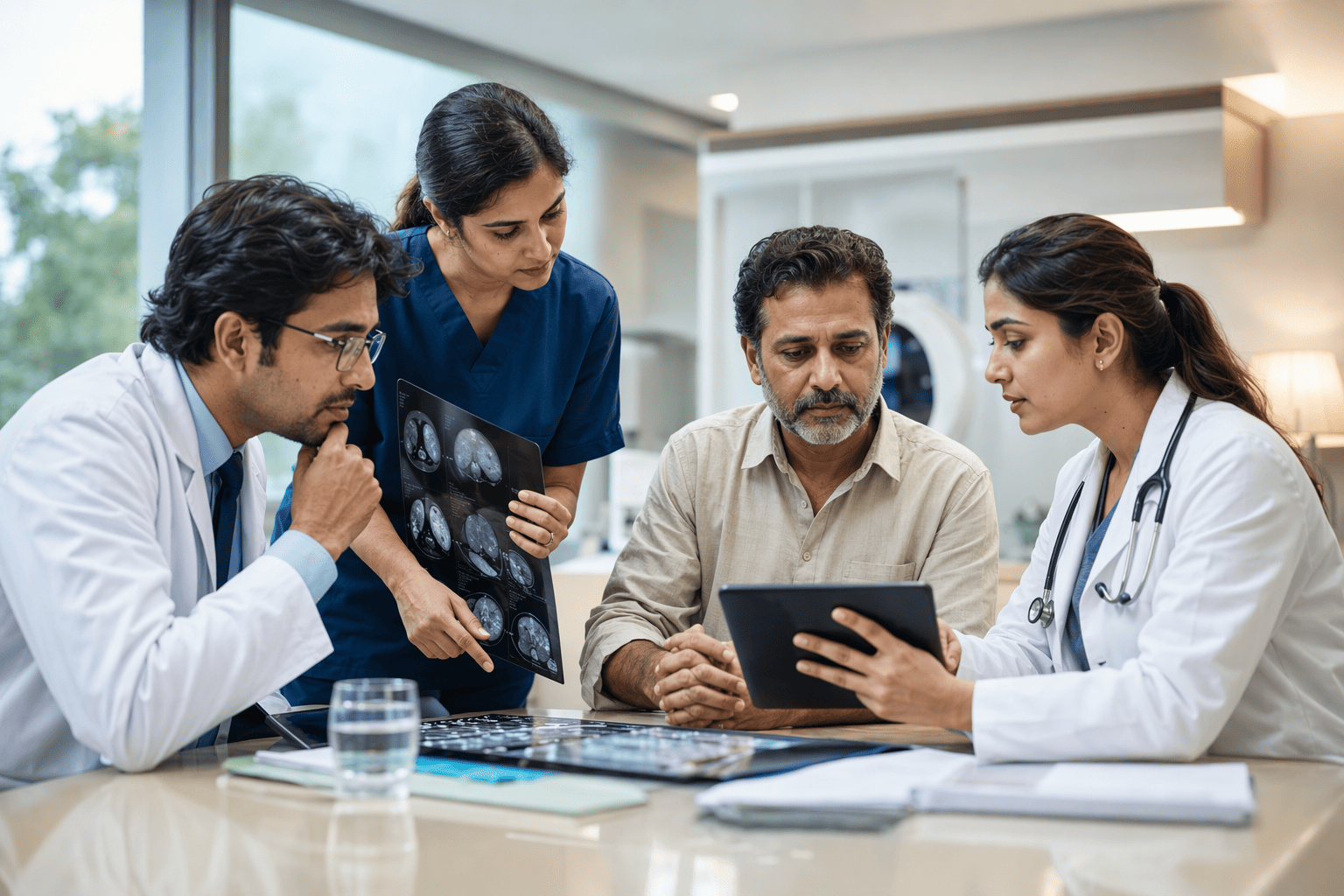
A rapid second opinion corrects the single biggest error in advanced cancer pain: continuing a treatment that has stopped working because you assume nothing else exists. An online consultation with an oncologist lets you upload the mechanism-based pain log you created in Step 1, list every drug and dose you have tried, and receive a concrete adjustment to your pharmacotherapy or a referral for an interventional procedure.
The friction is low. You do not need to travel from Faridabad to a Delhi NCR center for the initial evaluation; you only travel once a specific procedure is booked. Platforms that connect you to pain specialists or medical oncologists for urgent consultations reduce the gap between recognition of failure and execution of the next plan.
One avenue to explore is an online consultation with a specialist like Dr. Bharat Patodiya, whose practice charges ₹1,050 for a consultation booking and coordinates second-opinion access with multidisciplinary tumor boards for protocol review. For a patient stuck in a failing analgesic regimen, that single consultation can translate to an adjusted pharmacotherapy plan without a protracted wait for a physical appointment.
Step 7: Augment Relief with Integrative Non-Pharmacological Techniques
You have probably exhausted the standard dose escalations and are staring at a calendar, waiting for a procedure date. The frustration is real, and the impulse to try something else is completely human.
Integrative techniques are not a replacement for your medical plan. Only a few carry enough evidence to matter alongside it.
A 2019 meta-analysis published in JAMA Oncology found that acupuncture and acupressure are associated with a significant reduction in cancer pain intensity, though the evidence is not definitive enough to replace pharmacotherapy. Dr. Bharat Patodiya lists a practitioner certificate in Sujok / Six Ki Acupuncture obtained in 2010, and his practice recognizes it as part of palliative medicine for oncological patients. In that context, it is a low-risk comfort measure, not a curative treatment.
Add simple breathing exercises during breakthrough pain episodes and gentle positioning adjustments that offload pressure from a tumor site. Use these as tools that give you a small sliver of control. The one clear boundary: never delay a scheduled procedure or skip a medication adjustment to try them.
Conclusion
Medications stop working for two reasons. The disease has changed, or the pain pathways have rewired themselves. Either way, you need a different approach, not just a higher dose.
The ISSP-pathway sequence gives you that approach: mechanism-based reassessment, opioid rotation, adjuvant targeting, nerve blocks, intrathecal delivery, and a rehearsed crisis plan. It turns helplessness into a concrete protocol.
You live in a corridor, Faridabad to Delhi NCR, where each of these therapies is available. Your task now is to execute Step 1 at your next appointment. Say the words 'This is a mechanism problem, not a scale problem,' and make them listen.
Frequently Asked Questions
What advanced pain management options are available in Faridabad for cancer patients when standard medications fail?
When standard medications fail, Faridabad patients access a range of advanced interventions through pain clinics in Faridabad and tertiary centers in Delhi NCR such as AIIMS New Delhi:
Opioid rotation (switching to fentanyl or methadone)
Adjuvant analgesics
Ultrasound-guided nerve blocks
Epidural analgesia
Intrathecal pumps
How does palliative care differ from curative care for managing severe cancer pain?
Palliative care focuses on symptom relief and quality of life without aiming to cure the disease, whereas curative care targets the cancer itself. In advanced pain management, palliative care deploys the full ISSP pharmacologic and interventional escalation pathway regardless of whether the cancer is treatable.
What role does a multidisciplinary team and interventional pain specialist play in managing intractable cancer pain?
The multidisciplinary team for advanced cancer pain management has three key roles, each executing a mechanism-based plan that no single clinician can deliver alone:
The medical oncologist directs the cancer treatment.
The interventional pain specialist performs nerve blocks and implants pumps.
The palliative physician coordinates symptom control and home care.
How can a patient access emergency or out-of-hours support for severe cancer pain in Faridabad?
Pre-negotiate a crisis plan with a Faridabad home palliative provider (like Stoic Home Care) that has a direct escalation line to a tertiary center with 24/7 pain services. The plan should specify medications, doses, and contact numbers for every caregiver in the household.
What is the procedure for getting an urgent online consultation for intractable cancer pain from a medical oncologist?
Contact the oncologist's practice directly through their website or booking portal, upload your pain log and medication history, and request an urgent virtual appointment. You receive a pharmacotherapy adjustment or interventional referral without traveling to Delhi NCR, only going in person when a procedure is scheduled.
What non-pharmacological integrative techniques, such as Sujok acupuncture, can help alleviate severe cancer pain?
Sujok acupuncture (acupressure on hands and feet) is used in Indian palliative oncology settings as a complementary tool. A 2019 meta-analysis found acupuncture and acupressure are associated with reduced cancer pain intensity, but these are adjuncts only, they never replace pharmacotherapy or interventional procedures.
Sources
Best Oncologist | Hyderabad | Dr. Bharat Patodiya - www.drbharatpatodiya.com
Pain Management Clinic in Faridabad, India | Vedant Pain Clinic - www.vedantpainclinic.com
Multimodal Rehabilitation for Advanced Cancer Pain: a Narrative Review of Emerging Nonpharmacological Strategies | Current Oncology Reports | Springer Nature Link - link.springer.com
Comments