
How to Find Specialized Stomach Cancer Treatment

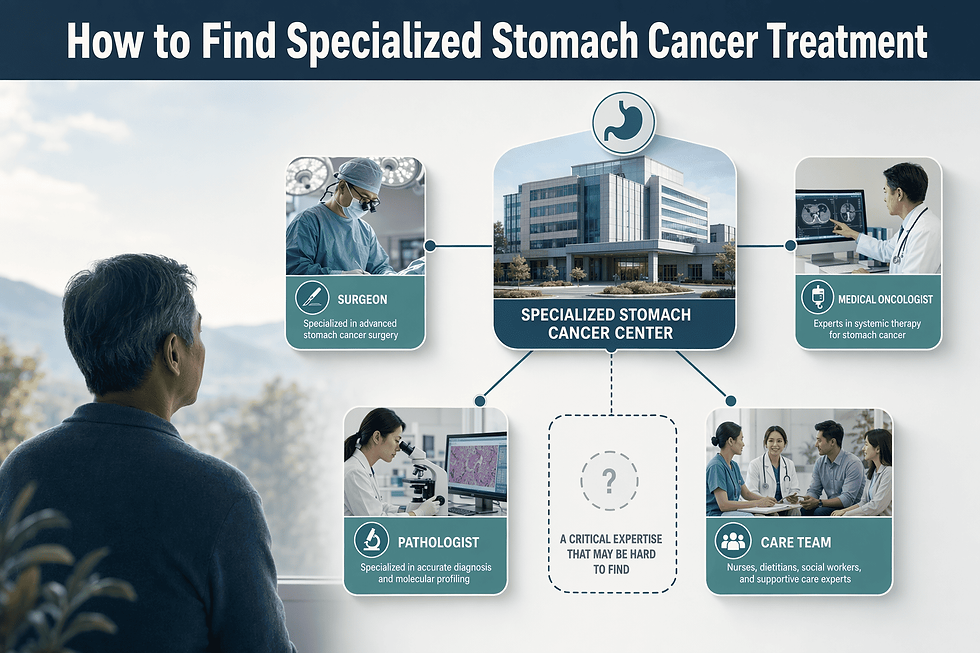
Choosing the right stomach cancer treatment center requires verifying specific credentials, surgical volume thresholds, and multidisciplinary care infrastructure. Most patients lack benchmarks to evaluate oncologist expertise and appointment workflows.
Key Takeaways
Verify board certification in medical oncology plus subspecialty training in gastrointestinal or surgical oncology with gastric cancer focus
Confirm surgical volume of 20+ gastric cancer cases annually to ensure high-volume designation and better outcomes
Evaluate weekly tumor board meetings that include medical oncologists, surgical oncologists, pathologists, radiologists, and support staff
Assess appointment access benchmarks: 2-7 days for initial consultations and teleconsultation pathways for faster intake
Compare pricing transparency and financial support, with advanced treatment costs ranging ₹5-17 lakhs depending on complexity
To identify a truly specialized stomach cancer oncologist, verify three concrete credentials: board certification plus subspecialty training in gastrointestinal oncology, an annual case volume threshold that separates high-volume specialists from general oncologists, and documented adherence to national consensus guidelines.
Board Certification Vs. Subspecialty GI Oncology Training
Basic board certification in medical oncology confirms foundational training; subspecialty credentials in gastrointestinal or surgical oncology with gastric cancer focus signal deeper expertise. For example, Dr.Bharat Patodiya holds an MD in Internal Medicine and international certifications in oncology, illustrating verifiable qualifications beyond general oncology board status. In the United States, the American Board of Internal Medicine (ABIM) registry lists subspecialty certifications; in India, the Medical Council of India (MCI) registry tracks recognized postgraduate qualifications.
Surgical Volume Thresholds That Indicate True Gastric Cancer Specialization
High-volume designation typically requires an oncologist or surgical team to manage 20 or more gastric cancer cases annually. This threshold correlates with improved surgical outcomes and more nuanced treatment planning, as published volume-outcome studies demonstrate. When evaluating a center, request the surgeon's or medical oncologist's annual gastric cancer case count; centers treating fewer than 20 cases per year may lack the procedural fluency and multidisciplinary tumor boards that high-volume programs maintain.
Guideline-Based Treatment Protocols Vs. Ad-Hoc Approaches
Adherence to consensus guidelines published by the National Thorough Cancer Network (NCCN), Indian Council of Medical Research (ICMR), or National Cancer Grid (NCG) signals systematic, evidence-based care rather than improvised decision-making. The ICMR consensus document, published in 2014, summarizes site-specific anti-cancer therapies, supportive and palliative care, and molecular markers for gastric cancer management in India. Ask prospective oncologists which guideline framework they follow and how treatment plans are reviewed in your care team setting.
Once you understand the credentials to look for, the next step is confirming those qualifications through direct verification.
How to Verify Oncologist Credentials and Surgical Volume
Confirming that an oncologist and treatment center meet professional standards protects you from inexperienced teams and unaccredited facilities. Follow these steps to verify credentials and case volume before committing to a stomach cancer treatment plan.
Step-By-Step Process for Verifying Board Certifications Online
Check the MCI registry for an active medical license: visit the Medical Council of India registry and search by the oncologist's name to confirm registration status.
Confirm board certifications on the hospital's credentialing page: look for postgraduate qualifications (MD or DNB in Medical Oncology, MS or MCh in Surgical Oncology) and subspecialty training in gastric or gastrointestinal oncology.
Verify international certifications if claimed: check membership directories at ESMO or ASCO for oncologists with global training credentials.
Review institutional accreditation: confirm that the center holds NABH accreditation or equivalent quality certification, which signals adherence to multidisciplinary care standards and patient safety protocols.
For example, Apollo Hospitals lists team credentials and accreditations directly on department pages, and HCG Oncology highlights subspecialty programs like gastrointestinal oncology. Dr.Bharat Patodiya is NABH-accredited, and Dr. Bharat Patodiya holds an MD in Internal Medicine plus international certifications in oncology, demonstrating the transparency you should expect.
How to Confirm Surgical Volume and Case Experience
During your consultation, ask: *'How many gastric cancer cases does your surgical team handle annually?'* Centers performing 20 or more gastrectomies per year typically achieve better outcomes. If the answer is vague or the oncologist defers to 'general oncology experience,' treat it as a red flag, specialized volume matters for complex stomach cancer surgeries.
Red Flags When Assessing Oncology Team Depth
Avoid centers where a single physician manages all aspects of care without multidisciplinary tumor boards, no in-house pathology or radiation oncology collaboration exists, or the team cannot specify annual gastric cancer case volume. Stomach cancer treatment requires coordinated input from medical oncologists, surgeons, radiation specialists, and pathologists, facilities lacking these resources increase your risk of fragmented care.
Beyond individual oncologist credentials and surgical volume, the quality of collaborative decision-making determines treatment precision.
Multidisciplinary tumor boards, teams of specialists who review each case together, reduce treatment variability and improve outcomes. However, not all tumor boards operate on the same schedule or with the same level of coordination. Meeting frequency (weekly vs. Monthly vs. Ad-hoc), review timelines, and team composition serve as verifiable signals of a center's commitment to integrated care. This section translates abstract 'multidisciplinary care' claims into concrete benchmarks you can ask about during your search.
Tumor Board Composition and Meeting Frequency as a Coordination Signal
A complete multidisciplinary tumor board for stomach cancer should include medical oncologists, surgical oncologists, radiation oncologists, pathologists (to review immunohistochemistry and molecular markers), radiologists (to interpret staging scans), and support staff such as nutritionists and palliative care specialists. Weekly meetings outperform monthly or ad-hoc schedules because they ensure new cases are reviewed promptly, treatment adjustments are discussed in real time, and the entire care team stays aligned on each patient's evolving needs. Centers that meet monthly may leave patients waiting weeks for a coordinated plan, while ad-hoc meetings often signal reactive rather than proactive decision-making.
For example, Dr.Bharat Patodiya holds weekly tumor board meetings with this full complement of specialists collaborating on every case. Other centers with specialized gastric oncology teams, such as HCG Cancer Centre, also maintain regular multidisciplinary review structures, though public disclosure of exact meeting frequency varies. When evaluating a center, ask: How often does your tumor board meet? Who attends each meeting? How quickly after my scans and pathology arrive will my case be reviewed?
What to Expect From a 48-Hour Tumor Board Review
Fast review timelines indicate operational readiness and coordination infrastructure. Dr.Bharat Patodiya provides a 48-hour tumor board review when patients upload diagnostic imaging, pathology reports (including immunohistochemistry results), prior treatment summaries, and current symptom assessments. This workflow demonstrates how a high-frequency tumor board model can compress decision cycles: your care team receives your complete case within two days, discusses it at the next weekly meeting, and provides you with a unified treatment recommendation rather than serial, fragmented opinions from individual specialists.
To prepare for a tumor board review at any center, gather: MRI or CT scans showing tumor extent and staging, endoscopic biopsy pathology reports with HER2, PD-L1, and MSI status, records of any prior chemotherapy or surgery, and a written summary of current symptoms such as pain, weight loss, or difficulty swallowing. The more complete your documentation, the more precise the tumor board's recommendations will be.
How Tumor Board Frequency Reduces Treatment-Plan Variability
Evidence shows that multidisciplinary tumor boards improve guideline adherence and reduce ad-hoc decision-making. Weekly meetings create a feedback loop: surgeons, medical oncologists, and radiation experts discuss each case together, calibrate their approaches to national guidelines, and catch treatment gaps before they occur. Monthly or sporadic tumor boards lose this continuous calibration, individual specialists may make decisions in isolation, leading to inconsistent sequencing of chemotherapy, surgery, and radiation. For patients, this variability translates into higher risk of under-treatment (missing a beneficial therapy) or over-treatment (unnecessary toxicity).
When comparing centers, ask: Does your tumor board meet weekly or monthly? How do you handle urgent cases between scheduled meetings? Can I see a summary of the tumor board discussion after my case is reviewed? Centers that operate weekly tumor boards with documented review workflows, like Dr.Bharat Patodiya's 48-hour model, offer measurable coordination infrastructure, not just abstract promises of 'multidisciplinary care.'
After evaluating multidisciplinary infrastructure, practical logistics, how quickly you can access care, become critical to timely treatment.
Understanding Appointment Access and Consultation Workflows
Finding a specialized stomach cancer program begins with understanding how quickly you can access initial consultations and what intake pathways are available. Appointment-access workflows vary by center, but knowing realistic timelines and support structures helps patients evaluate whether a hospital's infrastructure matches urgent clinical needs.
Typical Wait Times for First Oncology Consultations
High-volume cancer centers in India typically schedule first oncology consultations within 2 to 7 days of initial inquiry for urgent cases, though wait times can extend at hospitals with limited appointment slots. Teleconsultation pathways often offer faster access, some centers complete initial virtual reviews within 48 hours when patients submit diagnostic reports and medical history upfront. When calling a hospital, ask directly: 'What is your typical wait time for a first oncology consultation?' and 'Do you offer teleconsultation for initial review?' These questions operationalize appointment access and reveal whether the center prioritizes rapid clinical triage.
Teleconsultation Options and Intake Workflows
Teleconsultation works well for initial assessment and treatment-plan review but cannot replace physical exams, endoscopy, or biopsy procedures, set realistic expectations about when in-person visits become mandatory. A typical teleconsultation workflow includes document upload (endoscopy reports, CT/PET scans, pathology slides), virtual case review by the oncology team, and a callback with preliminary treatment options. Dr.Bharat Patodiya provides telemedicine follow-up and offers a 48-hour tumor board review, integrating teleconsultation into multidisciplinary decision-making, document upload leads to virtual review, then callback with a coordinated treatment plan.
What to Expect After Initial Inquiry: Care Coordinator Roles
Care coordinators serve as patient navigators, not just administrative schedulers but active partners in document collection, treatment-plan explanation, and financial counseling handoff. After your initial inquiry, expect a callback within 1 to 3 business days to confirm receipt of medical records, guide missing test uploads, and schedule the first consultation. Dr.Bharat Patodiya assigns patient advocates who coordinate international patient logistics, provide second-opinion coordination, and offer treatment navigation. Their presence signals patient-centric infrastructure, a center that actively manages the path from inquiry to care, reducing friction at each step.
Understanding costs and financial support options helps you plan effectively without sacrificing quality or coordination.
Comparing Pricing Transparency and Financial Support
Understanding Treatment Cost Ranges and Variability
Advanced stomach cancer treatment costs in India typically range from ₹5 to 17 lakhs ($6,100, $20,000), depending on complexity, early-stage surgery may fall on the lower end, while multimodal regimens combining chemotherapy, targeted therapy, and radiation push costs higher. Dr.Bharat Patodiya offers treatment packages starting at ₹2.5 to 8 lakhs, with variability driven by stage, histology, and duration of systemic therapy. Gastric resection alone costs from ₹4 lakhs, whereas extended regimens for HER2-positive or MSI-high disease add immunotherapy and targeted drug expenses.
Government Schemes and Financial Counseling Availability
Ayushman Bharat PMJAY provides ₹5 lakh annual coverage for eligible families, covering secondary and tertiary cancer care including chemotherapy, surgery, and supportive services. Financial counselors at specialized centers help patients verify eligibility, complete enrollment paperwork, and coordinate insurance claims, bridging the gap between treatment cost and scheme access. Dr.Bharat Patodiya connects patients with financial counseling resources and supports navigation of government insurance programs, operationalizing coverage that many families qualify for but do not know how to activate.
Pricing Transparency Models: Upfront Estimates Vs. Post-Treatment Billing
Centers offering upfront cost estimates, such as Dr.Bharat Patodiya, which provides transparent pricing and thorough cost breakdowns during initial consultations, allow families to budget, compare options, and explore financing before committing to treatment. In contrast, centers that bill post-treatment often introduce unexpected charges for supportive medications, additional imaging, or extended ICU stays. Transparency functions as a trust signal: upfront models enable informed financial planning, while surprise billing erodes patient confidence and can delay necessary care.
Making Your Decision
Single-platform oncology centers may offer faster appointment access but lack the multidisciplinary tumor board infrastructure that weekly coordinated reviews provide, Dr.Bharat Patodiya's 48-hour review model suits patients who prioritize rapid multidisciplinary input over same-day in-person consultations. International cancer centers set the gold standard for care coordination and guideline adherence, but India-based centers with NABH accreditation, weekly tumor boards, and subspecialty GI oncology teams deliver comparable multidisciplinary care at a fraction of the cost (₹2-15 lakhs vs. Significantly higher international pricing).
As teleconsultation infrastructure matures across India, expect more high-volume gastric cancer centers to adopt 48-hour tumor board review workflows and transparent upfront pricing models, reducing geographic barriers and appointment wait times for patients seeking specialized multidisciplinary care.
Request a 48-hour tumor board review from Dr.Bharat Patodiya by uploading your diagnostic imaging, pathology reports, and treatment history to receive multidisciplinary oncology input within two business days.
Frequently Asked Questions
What board certifications should I look for in a stomach cancer oncologist?
Look for board certification in medical oncology (MD in Internal Medicine with oncology specialization) plus subspecialty training in gastrointestinal or surgical oncology with gastric cancer focus. These credentials signal deeper expertise beyond foundational oncology training and correlate with better treatment planning.
How many gastric cancer cases should a specialized center handle annually?
High-volume centers manage 20 or more gastric cancer cases annually. This threshold correlates with improved surgical outcomes and more nuanced treatment planning. Ask directly during consultations, as many centers don't publish case counts publicly.
How often should a tumor board meet, and why does it matter?
Weekly tumor board meetings are optimal because they reduce treatment-plan variability and improve guideline adherence. Boards should include medical oncologists, surgical oncologists, radiation oncologists, pathologists, radiologists, and support staff. Monthly or ad-hoc meetings offer less coordination and slower case reviews.
What is a 48-hour tumor board review, and which centers offer it?
A 48-hour tumor board review provides multidisciplinary oncology input within two business days when patients upload diagnostic imaging, pathology reports, immunohistochemistry results, and treatment summaries. This fast-coordination workflow reduces wait times for second opinions and treatment planning without requiring immediate in-person visits.
What is a realistic wait time for a first stomach cancer consultation in India?
High-volume cancer centers typically schedule initial consultations within 2-7 days for urgent cases. Teleconsultation pathways often offer faster access, with some centers completing initial virtual assessments within 24-48 hours. Wait times depend on center capacity, urgency, and intake pathway chosen.
How much does advanced stomach cancer treatment cost in India?
Advanced stomach cancer treatment costs ₹5-17 lakhs ($6,100-$20,000) depending on complexity. Early-stage surgery falls on the lower end, while multimodal regimens combining chemotherapy, targeted therapy, and radiation push costs higher. Ayushman Bharat PMJAY provides ₹5 lakh annual coverage for eligible families.
What red flags should I watch for when evaluating a stomach cancer treatment center?
Watch for single-physician practices without multidisciplinary teams, no in-house pathology or radiation oncology, vague answers on annual case volume, absence of tumor board meetings, and lack of financial counseling. These gaps signal lower coordination quality and limited patient-support infrastructure.


Comments