
Where to Find Complete Oral Cancer Care Under One Roof in Faridabad: Surgery, Chemotherapy, and Radiation

Introduction
A suspicious mouth ulcer has not healed for three weeks. Your biopsy report confirms squamous cell carcinoma. Suddenly, you are thrust into a maze of consultations: one hospital for surgery, another for radiation, and perhaps a third for chemotherapy. In Faridabad, this fragmented, exhausting journey is no longer the only option.
Oral cancer is the most common malignancy among Indian men, fueled by high rates of tobacco and areca nut use. A 2016 study in the Journal of Cancer Research and Therapeutics noted oral cancer accounts for roughly 30% of all cancers in India. The logistical burden of shuttling between unconnected specialists delays treatment and amplifies stress.
Integrated care changes this. Surgery, chemotherapy, and radiation are planned and delivered by a single coordinated team, often under one roof. This article maps exactly where that model exists in Faridabad, what it costs, and what makes it clinically superior.
Key Takeaways
Dr. Bharat Patodiya had a patient last month who arrived weighing 14 kilos less than he should have, not from the cancer but from the commute. He had been traveling three hours a day for radiation at a Delhi center that did not coordinate with his surgeon back home. His treatment stalled twice before he walked into Metro Cancer Institute.
When a cancer diagnosis forces you to choose a treatment center fast, you need the bottom-line facts. Here is what matters most in Faridabad.
Single-roof vs. coordinated network: Metro Cancer Institute is the only center in Faridabad that houses surgical oncology, medical oncology, and TrueBeam-based radiation oncology on-site with a unified multidisciplinary tumour board. MOC Cancer Care provides coordinated medical oncology and thorough supportive care but refers out for on-site radiation and major surgery.
The tumour board is the clinical differentiator: A head and neck surgeon, medical oncologist, and radiation oncologist reviewing your scans together before you ever start treatment directly reduces fragmented care and delays.
Integrated local care avoids the daily Delhi commute: Eliminating the 2-to-3-hour daily round trip during a six-week radiation course preserves your weight, your energy, and your treatment completion rate.
Cost transparency starts at ₹2.5 lakhs: Dr. Bharat Patodiya offers transparent mouth cancer treatment packages starting at ₹2.5 to 8 lakhs, and Ayushman Bharat PM-JAY provides up to ₹5 lakh coverage at empanelled hospitals to reduce the financial shock.
That patient who walked in underweight finished his full radiation course on schedule. His weight stabilized by the third week. That is what eliminating the commute and running a single tumour board does.
Faridabad’s Comprehensive Oral Cancer Centers: Where Oncology, Radiation, and Surgery Meet
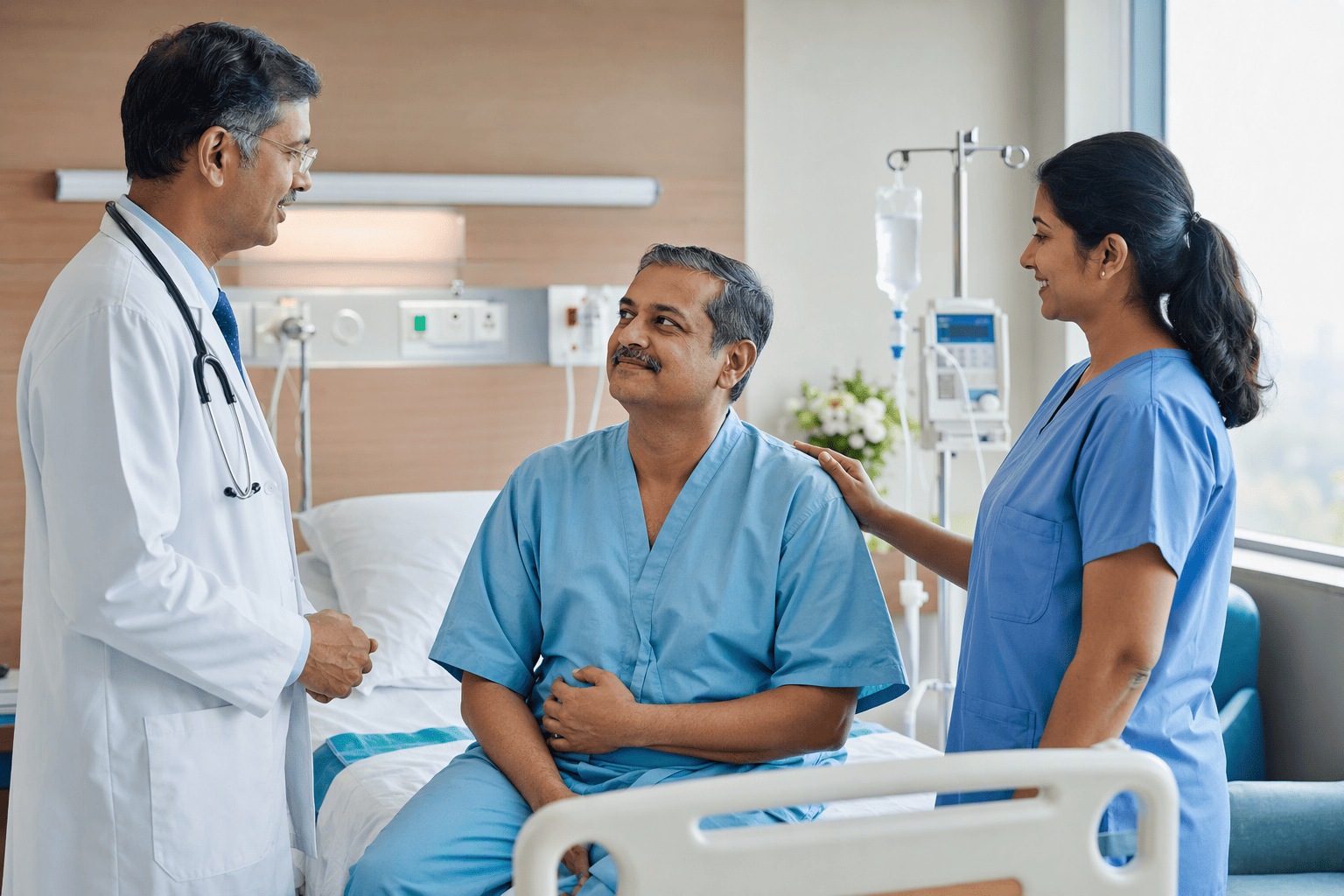
Dr. Bharat Patodiya, a jaw reconstruction specialist who operates across Jaipur, puts it plainly: "In oral cancer, the first surgery is the surgery that cures." He has watched patients shuttle between three buildings in three weeks for a single treatment plan. You are not looking for a facility that does one thing well. You need a center where a head and neck surgeon, a medical oncologist, and a radiation oncologist sit in the same room and build your treatment sequence from the first biopsy result. That is the definition of thorough care, and it is rare outside major metros.
Metro Cancer Institute at Metro Hospital, Faridabad, is the city's primary facility offering this exact model under one roof. It explicitly lists oral cavity cancers among the solid tumours it treats and runs a formally structured multidisciplinary tumour board. The center integrates three core departments:
Surgical oncology: The wing handles wide local excisions and neck dissections.
Medical oncology: The unit delivers chemotherapy, immunotherapy, and targeted therapy in a dedicated daycare chemo suite.
Radiation oncology: The department operates a TrueBeam linear accelerator with HyperArc technology, which is designed to deliver highly precise radiation to complex head and neck targets while reducing dose to the salivary glands and jawbone.
Then there is a critical piece most families overlook: the support infrastructure. Metro Cancer Institute has advanced diagnostics on-site, including PET-CT, and it employs the SSI Mantra robotic surgical system. The robotic platform offers a degree of instrument articulation and tremor filtration that can improve surgical precision during transoral resections, though the final decision between robotic, laser, and open surgery depends entirely on your tumour's exact location and depth. A positive surgical margin or a tumour depth of more than 5 mm significantly increases the risk of local recurrence, so the quality of that first surgery is everything.
MOC Cancer Care, rooted in the Haryana and North India corridor, fills a different but complementary role. Its service pages emphasize supportive oncology services that larger hospitals sometimes underdeliver: dedicated onco-physiotherapy and palliative care integrated from day one. However, MOC does not explicitly confirm on-site radiation oncology or major head and neck surgical oncology on its published service list. If you choose MOC, you are selecting excellent medical oncology and a carefully coordinated referral pathway rather than a literal single building housing all three modalities. For some patients, that distinction matters enormously. For others, the priority is a doctor who will coordinate everything personally, even if a short trip is required for the radiation phase. That trade-off between absolute colocation and a tight-knit referral network is not theoretical. Dr. Patodiya recently coordinated a case where a Faridabad patient's radiation was handled at one center and the reconstructive flap surgery at another, ninety minutes away. The two surgical teams reviewed the same scan together before the first incision. That is the standard you are measuring against, not a building's address.
The True Cost of Oral Cancer Care: Financial Planning and Support Options
A clinic in Faridabad handed a family a ₹7 lakh estimate for a surgery-plus-radiation plan. They had never heard of Ayushman Bharat. The navigator at the desk flagged their eligibility, and the out-of-pocket dropped to under ₹1 lakh. That gap, between the first quote and what you actually pay, is what this section maps.
Cost Element | Early-Stage (Surgery ± Radiation) | Locally Advanced (Surgery + Chemoradiation) | Stage 4 / Metastatic (Systemic Therapy Focus) |
Typical Total Range | ₹2 to 5 lakhs | ₹5 to 10 lakhs | ₹2.5 to 15+ lakhs (ongoing) |
Surgery Component | ₹1 to 3 lakhs | ₹2 to 4 lakhs (with reconstruction) | Variable; often palliative-intent |
Radiation Component (6 to 7 weeks) | ₹1.5 to 2.5 lakhs (if needed) | ₹2 to 3.5 lakhs | Often omitted or short-course palliative |
Chemotherapy / Immunotherapy | Minimal to none | ₹50,000, ₹1.5 lakhs (per cycle; 3 to 6 cycles typical) | Monthly costs can exceed ₹1 lakh; immunotherapy higher |
Key Cost-Reduction Levers | Ayushman Bharat empanelment; short-stay surgery | Ayushman Bharat; clinical trial enrollment | Clinical trials; generic chemotherapy |
Government hospitals such as Tata Memorial provide treatment at ₹1.5 to 5 lakhs with 50 to 70 percent subsidies for eligible patients, though wait times can be substantial. Ayushman Bharat PM-JAY provides up to ₹5 lakh coverage at empanelled hospitals, and many private centers in Faridabad now accept this. On the medication side, generic cancer medications cost 80 percent less than branded drugs once they enter the market, though substitution decisions must be made by your oncologist and never at the pharmacy counter.
Financial counselors at cancer centers verify government scheme eligibility, coordinate charitable aid applications, and connect patients with clinical trial opportunities. In practical terms, clinical trial participation can save ₹5 to 25 lakhs in treatment costs, as the investigational drug and associated monitoring are typically covered by the trial sponsor. Always ask your center's patient navigator to check your Ayushman Bharat eligibility and screen for open head and neck cancer trials before you commit to a self-pay treatment plan.
That family in Faridabad started treatment within three weeks. The navigator who caught their eligibility also enrolled them in a transport stipend program the hospital ran with a local NGO, a detail that saved them another ₹12,000 over the radiation phase. Those add-ons compound quietly, and the navigator's desk is where you catch them early.
Faridabad vs. Delhi: Weighing the Real Benefits of Integrated Local Care
The impulse to seek care at a Delhi cancer center is understandable. Delhi has a higher density of sub-specialists and brand-name oncology institutions. But integrated local care brings its own set of clinical and quality-of-life advantages that directly affect outcomes. Here is the comparison that matters.
Treatment fragmentation risk: In Faridabad, a facility like Metro Cancer Institute coordinates surgery, chemotherapy, and radiation through a single multidisciplinary tumour board, meaning your medical oncologist has seen your surgical pathology report before prescribing the first chemo cycle. In Delhi, you may be coordinating between an independent surgeon, a separate radiation center, and a medical oncologist who works in a different hospital, with you as the only information courier.
Daily commute burden during radiation: A six-to-seven-week radiation course for oral cancer requires daily weekday visits. A Faridabad-to-Delhi round trip can consume three hours. That daily physical toll, on a patient already struggling with mucositis, dysphagia, and weight loss, directly threatens treatment completion. Staying local preserves calories and energy that you need for tissue healing.
Speed of coordinated escalation: If you develop a post-operative complication or a concerning symptom during chemoradiation, a single-roof team can convene the relevant specialists on the same hospital visit. In a multi-center Delhi setup, you bounce between different hospital emergency rooms and disjointed on-call rosters.
Advanced technology parity: Faridabad does not mean second-tier technology. Metro Cancer Institute operates TrueBeam with HyperArc, PET-CT on-site, and the SSI Mantra robotic system. The marketed positioning as a Delhi alternative is built on equivalent technology with reduced logistical friction.
Dr. Bharat Patodiya recalls a patient who delayed radiation for two weeks because the daily Delhi commute became impossible after the first five sessions. Once the treatment moved to Faridabad, the patient completed the remaining 28 fractions without missing a single day. The calories saved on travel went directly into tissue repair.
The Unseen Pillars of Treatment: Key Supportive Care Services
Four treatment-enabling services that rarely appear in a hospital's headline brochure are key for completing surgery, radiation, and chemotherapy:
Nutrition support: A dedicated oncology dietitian who manages a feeding tube proactively or designs calorie-dense liquid diets you can swallow through painful mucositis keeps the treatment on schedule, because losing 10 percent or more of your body weight during radiation may force your oncologist to pause treatment, which directly reduces the biological effectiveness of the radiation course.
Physiotherapy: MOC Cancer Care lists onco-physiotherapy among its supportive services; for oral cancer patients, this means pre-treatment jaw mobility exercises, post-operative shoulder rehabilitation after neck dissection, and lymphedema management.
Pain management: Palliative care integrated from diagnosis improves symptom control, reduces unnecessary hospitalizations, and in some cancer types has been associated with longer survival. In oral cancer, this means expert management of neuropathic tumour pain, mucositis, thick secretions, and the profound psychosocial distress that accompanies facial disfigurement and loss of speech or swallowing function. Both Metro Cancer Institute and MOC Cancer Care can connect you to these services, but the integration varies.
Psychological support: Psycho-oncology services, whether through a clinical psychologist on staff or a structured referral pathway, address the anxiety, depression, and body-image trauma that erode treatment adherence for a cancer that alters how you look, speak, and eat. Ask about this during your first consultation, not when you are already struggling.
Inside the Multidisciplinary Tumour Board: Getting a Timely Expert Opinion
Dr. Bharat Patodiya paused the slides. The surgeon had just argued for surgery first. But the radiation oncologist was shaking her head, PET-CT in hand, pointing to the proximity of the primary tumour to the base of the tongue. Upfront chemoradiation, she countered, would give this 42-year-old father the same survival odds with his speech intact. After twenty minutes of back-and-forth across pathology, radiology, and medical oncology, the room settled on a single written plan: induction chemotherapy followed by concurrent chemoradiation. The patient walked into his consult three days later and left with that plan, not three conflicting opinions to reconcile on his own.
A tumour board is not a casual conversation in the corridor. It is a scheduled, documented meeting where a head and neck surgeon, a radiation oncologist, a medical oncologist, a pathologist, and often a radiologist review your imaging, your pathology slides, and your functional status together. The key components and outputs include:
Participants: The board convenes the head and neck surgeon, radiation oncologist, medical oncologist, pathologist, and radiologist.
Process: They review your imaging, pathology slides, and functional status collectively.
Output: The result is a single, evidence-informed treatment sequence that accounts for surgical margin status, perineural invasion, radiation field design, and optimal chemotherapy regimen.
This is the mechanism that prevents the common disaster where a patient has surgery first, only to find that the tumour board would have recommended upfront chemoradiation to preserve the tongue.
Metro Cancer Institute documents a formal multidisciplinary tumour board as a core component of its cancer program. In practice, this means your case is typically reviewed within days of your biopsy and imaging results being complete, and you walk into your consult with a consensus recommendation. MOC Cancer Care approaches the same problem through a structured second opinion model. Its free second opinion service for North Indian patients allows you to submit slides, scans, and reports, which its medical oncology team reviews and for which they coordinate specialist input where needed. The service does not replace a tumour board, but it provides a rapid, low-barrier expert checkpoint before you commit to a treatment plan. When you are selecting a center, do not simply ask if a tumour board exists. Ask how soon after your PET-CT the board will review your case, and whether you will receive the written consensus plan at your next appointment. A tumor board that meets once a month and takes two weeks to issue a report is not serving an aggressive oral cavity cancer well. Dr. Patodiya later told the 42-year-old patient that his speech was likely preserved because the board caught the sequencing problem early, not because the disease was easy.
Frontiers of Oral Cancer Treatment: Precision Medicine, Home Chemotherapy, and Surgical Innovation
Thorough care in 2026 is not just about having all three modalities in one building. It is about how those modalities are delivered. Metro Cancer Institute's SSI Mantra robotic system and HyperArc-enabled TrueBeam are examples of precision tools that aim to deliver maximum tumour control with minimum collateral damage to the jawbone, the salivary glands, and the pharyngeal constrictors that govern your ability to swallow after treatment. This is the clinical frontier for local control: rates as high as 90 percent can be achieved with either radiation therapy or surgery in small cancers of the anterior tongue, the floor of the mouth, and buccal mucosa, and the precision delivery systems available in Faridabad are designed to approach those benchmarks while limiting the functional cost.
For systemic therapy, the conversation has moved far beyond traditional cisplatin and 5-FU. Key developments include:
Immunotherapy and targeted therapy: Immunotherapy with immune checkpoint inhibitors and targeted therapy against specific molecular alterations such as EGFR are now standard components of the oral oncology armamentarium for recurrent or metastatic disease. Aligned with this, Dr. Bharat Patodiya's protocols incorporate immunotherapy and targeted therapy pathways alongside standard chemotherapy.
Home-based chemotherapy: On the delivery side, home-based chemotherapy services are offered through certified nursing teams for appropriate low-risk regimens, which can dramatically reduce hospital exposure during the immunosuppressed phases of treatment. Not every regimen qualifies, high-dose cisplatin and investigational protocols still require in-center administration, but for maintenance or palliative-intent regimens, receiving your infusion at home with telemedicine monitoring is now a real option in the Faridabad ecosystem.
Conclusion
Dr. Bharat Patodiya recalls a 54-year-old welder from Ballabhgarh whose family assumed six weeks of daily Delhi trips were unavoidable. They weren't. His tumour board review happened locally, surgery followed within eight days, and the daily commute he'd budgeted for never materialised. He finished treatment and went back to work; the family didn't drain their savings on transport and lost wages.
That reality is now available in Faridabad. The Metro Cancer Institute runs surgical oncology, medical oncology, and TrueBeam-based radiation oncology under one roof, guided by a multidisciplinary tumour board. PET-CT and robotic surgery sit on the same premises. MOC Cancer Care & Research Centre adds the coordinated medical oncology and supportive care layer patients lean on when on-site radiation or major surgery is not the defining requirement.
Together, these two centers remove the daily Delhi commute from the treatment equation. That trip, repeated for weeks, destroys nutritional intake and functional strength when a patient can afford neither loss. A local ecosystem also makes integrated clinical decision-making the default, not a scramble. Fragmented care sequences happen when a surgeon in one city and a radiation oncologist in another never sit in the same room with your scans.
Your first move does not require a long list of opinions. Secure a tumour board review at one of these centers within a week of your completed staging scans. Oral cancer does not wait.
Frequently Asked Questions
Which hospitals or cancer centers in Faridabad offer medical oncology, radiation therapy, and surgical oncology for oral cancer under the same roof?
Metro Cancer Institute at Metro Hospital, Faridabad, is the primary facility offering all three modalities on-site, coordinated through a formal multidisciplinary tumour board:
Radiation oncology: Operates a TrueBeam linear accelerator with HyperArc.
Surgical oncology: Performs head and neck resections.
Medical oncology: Delivers chemotherapy and immunotherapy.
What are the typical costs for thorough oral cancer treatment in India, and what financial support options are available?
Thorough oral cancer treatment in India ranges from ₹2 to 5 lakhs for early-stage disease to ₹5 to 15+ lakhs for advanced or metastatic cancer when all modalities are needed. Ayushman Bharat PM-JAY provides up to ₹5 lakh in coverage at empanelled hospitals, and generic chemotherapy drugs can reduce medication costs by up to 80 percent compared to branded equivalents.
How do facilities in Faridabad compare for integrated cancer care versus traveling to Delhi or other major centers?
Faridabad's Metro Cancer Institute offers single-roof integrated care with a unified tumour board, eliminating the daily three-hour Delhi commute during a six-week radiation course. This preserves the patient's weight and energy critical for treatment completion. Delhi centers may offer deeper subspecialization in rare reconstructions, but for most oral cancers, Faridabad's technology and coordination are equivalent.
What supportive care services should accompany oral cancer treatment in Faridabad, and where are they available?
Key supportive services include oncology nutrition counselling to prevent treatment-interrupting weight loss, onco-physiotherapy for jaw mobility and post-neck-dissection shoulder rehabilitation, palliative care for symptom control from diagnosis onward, and psycho-oncology for body-image and anxiety management. Key providers include:
Oncology nutrition counselling: Prevents treatment-interrupting weight loss.
Onco-physiotherapy: Addresses jaw mobility and post-neck-dissection shoulder rehabilitation.
Palliative care: Provides symptom control from diagnosis onward.
Psycho-oncology: Manages body-image and anxiety issues.
MOC Cancer Care explicitly lists onco-physiotherapy and palliative care, while Metro Cancer Institute provides nutrition and psychological support through its oncology program.
How can patients get a timely multidisciplinary opinion for oral cancer in Faridabad, and what does a second opinion process involve?
At Metro Cancer Institute, you request a tumour board review after your biopsy and PET-CT are complete; the head and neck surgeon, radiation oncologist, and medical oncologist review your case together and issue a single consensus plan, often within the same week. MOC Cancer Care offers a free second opinion service for North Indian patients where you submit your slides, scans, and reports for a medical oncology-led review with coordinated specialist input.
What new or emerging treatment approaches beyond standard chemoradiation are available in India for oral cancer?
Robotic surgery using the SSI Mantra system provides enhanced precision for transoral resections in Faridabad. For systemic therapy, immunotherapy with checkpoint inhibitors and targeted therapy against EGFR are now standard in recurrent or metastatic disease. Home-based chemotherapy through certified nursing teams is available for appropriate low-risk maintenance regimens, reducing infection exposure, though high-dose cisplatin still requires in-center administration.
Sources
How to Reduce Mouth Cancer Treatment Costs Without Compromising Quality: 2026 Complete Guide - www.drbharatpatodiya.com
How to Cut Mouth Cancer Treatment Costs - www.drbharatpatodiya.com
How to Find Mouth Cancer Specialists With Support - www.drbharatpatodiya.com
Best Cancer Hospital in Faridabad - Metro Cancer Institute - metrohospitalfaridabad.com
Oncology Hospital in Haryana, North India | Advanced Cancer Care & Oncology Treatment | MOC Cancer Care & Research Centre - www.mocindia.co.in
Lip and Oral Cavity Cancer Treatment (PDQ®) - NCI - www.cancer.gov
Oral Cancer | NIDCR - www.nidcr.nih.gov

Comments